Havre de Grace library to host War of 1812 talk

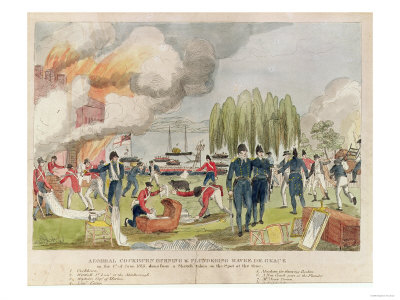
Admiral Cockburn doing his worst in Havre de Grace, May 1813.

David Healey, local author of 1812: Rediscovering Chesapeake Bay’s Forgotten War, will present an engaging talk at the Havre de Grace Library on Tuesday, January 17 at 6:30 p.m. He will look at the personalities of the War of 1812 – both the “heroes” and the “villains” of the conflict.

Date: Tuesday, January 17, 2012, 6:30 p.m.
Location: Havre de Grace Library, 120 N. Union Ave., Havre de Grace
Topic: Heroes and Villains of 1812: A Look at the Personalities in the War of the Chesapeake
Speaker: David Healey, author

For the full post over at the Havre de Grace 1812 Project.

Posted in News and Events | Tagged , , , | Leave a comment

Antietam program to look at impact on Marylanders

No Civil War battles were fought in Cecil County, Maryland, but that doesn’t mean the war didn’t touch the homefront in other ways. Dispatches, letters and reports published in the Cecil Democrat and other newspapers kept local residents informed as they yearned for news about loved ones on the battlefield. There were times when the war raged nearby, and affected countians strongly.

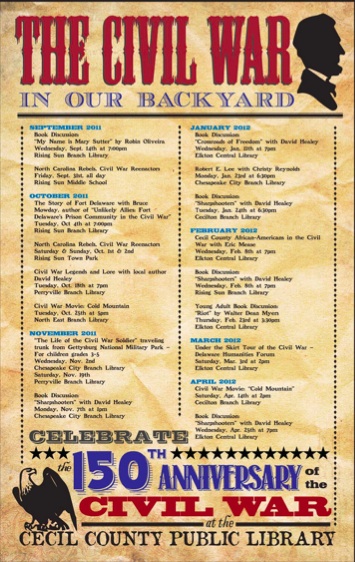
One such event was the battle of Antietam in September 1862. It’s this battle, and its importance to Marylanders in particular, that will be the focus of the 7 p.m. Wednesday, Jan. 11 book discussion and program “Crossroads of Freedom” at the Elkton Central Library. In this book, author James McPherson examines not so much the battle as the politics and personalities surrounding it. The discussion will be led by local author David Healey.

The Confederacy was desperate for recognition by the British and French governments, and as the fortunes of war ebbed and flowed, the Union waged a political counterattack of its own in Europe and England. As McPherson emphasizes in the book, both sides sought a decisive military victory to support their claims in Europe.

Victory was elusive for the Union. At that time, George B. McClellan was commander of the Army of the Potomac. McClellan was the consummate organizer and administrator (his abilities if not his personality would be echoed later by another American general, Dwight Eisenhower). He had built a formidable fighting force. And yet he seemed reluctant to actually fight the enemy, claiming at every turn that he was ill-equipped or outnumbered. In his book, McPherson offers an interesting study of this complicated and talented individual in whom President Abraham Lincoln had to reluctantly put his trust.

Unfortunately for McClellan, it was Robert E. Lee who commanded the Confederate Army of Northern Virginia. Lee was a military engineer by training (he spent three years in Baltimore building a fort that was never used) and early in the war was given the nickname “Granny Lee” by some who saw him as a milquetoast. When chance and fate passed command of the South’s largest army to Lee, he would turn out to be one of history’s most daring and capable military commanders.

When Lee marched his forces into Maryland, and McClellan finally mobilized to meet the threat to the Union, the result was the huge battle at Sharpsburg. In a single day, roughly 25,000 Americans would be killed or wounded. Many Cecil Countians fought and died there, including the men of Snow’s Battery, an artillery unit made up of volunteers mainly from the Port Deposit area. At least one local father traveled to the battlefield and brought home his wounded teenage son.

Ultimately, it was the Union victory at Antietam that gave Abraham Lincoln the confidence and political capital to make his famous Emancipation Proclamation, freeing enslaved African-Americans in the states “in rebellion” … but not those in border states such as Maryland.

As we mark the 150th anniversary of this battle, this exploration of James McPherson’s book about the events leading up to Antietam—including events before and after the battle in Cecil County–should be a fascinating discussion for Civil War buffs. To register for the program and receive a copy of the book please call the library at 410-996-5600, ext. 481. (Reading the book is helpful, but not required).

Posted in News and Events | Tagged , , | Leave a comment

Witches tossed overboard to stop storms

I just had to share this bit about tossing witches overboard … after a long voyage, it must have been a convenient way to ride the ship of a busybody!

From GREAT STORMS OF THE CHESAPEAKE:

“The weather in this New World was of great interest not only to future colonists, but to curious Old World weather watchers. Then, as now, observing the weather was something of an obsession among people from all walks of life. In “A Relation of Maryland” published in 1635, the writer praises the weather in the colony: “The temper of the Ayre is very good, and agrees well with the English … In Summer it is hot as in Spain, and in Winter there is frost and snow; but it seldom lasts long. The windes there are variable; from the Souths comes Heat, Gusts, and Thunder; from the North, or North-West, cold-weather, and in Winter, Frost and Snow; from the East and Southwest, Raine.”

If the writer seems to have downplayed the worst of the weather, it should come as no surprise that he was writing a kind of travel brochure to lure potential immigrants. These optimistic or favorable descriptions were thus to be expected.

At a time when the cause of storms was beyond the knowledge of even the most educated scientists, a great deal of superstition still went hand-in-hand with attempting to understand and predict the weather, and these superstitions were heightened at sea. Several accounts of voyages to the New World describe how desperate, storm-tossed passengers sought to blame the bad weather on a witch aboard the ship. In some cases, the crew and passengers settled upon a likely suspect and threw her overboard. This murderous act did nothing to lessen the effects of the storm except in the survivors’ imaginations, but it probably did rid the ship of an annoying old nag.”


Posted in Delmarva History, Writers & Writing | Tagged , , | Leave a comment

Writing goals for 2012

 I’m not in the habit of making New Year’s Resolutions, but I’m feeling more positive about 2012 as a writer. There are lots of day-to-day goals that involve producing eBooks (for others), my ghostwriting project, teaching, speaking, and duties as president of the Historical Society of Cecil County. Those (well, not the HSCC!) help pay the bills. Here are the “big goals” I have in mind for 2012 as a writer:

  • Finish GREAT STORMS OF THE CHESAPEAKE for the History Press. The manuscript is due in June, and I have about two-thirds of the 40,000-word rough draft done. And did I mention the 70 images to track down and caption? I’m discovering lots of great history and anecdotes along the way. There are still many photos, an introduction, etc., to nail down, but the book is coming along and should be out by summer.
  • Finish edits for THE HOUSE THAT WENT DOWN WITH THE SHIP, which is the first in my “Delmarva Renovators” mystery series about the crew of an online home improvement show that has a habit of having dead people turn up on the job site. This story is set in the waterfront town of Chesapeake City, Maryland. I’ve really enjoyed working with my wonderful publisher Bella Rosa Books in helping to make this book better. The book should be out in spring/summer in both print and ebook.
  • Outline the next “Delmarva Renovators” mystery … tentatively set in Lewes, Del., with the title THE HOUSE THAT WALKED THE PLANK. There will be a few pirate legends in this one, I’m thinking. Aaarggh!
  • Rewrite TIME REICH … this historical thriller is about the threat of Nazi time travel, and frankly, I’ve had a tough time swallowing the sci fi element of the story that I was talked into when workshopping this at the Stonecoast MFA pop fic group. But sometimes we have those Ah ha! or Eureka! moments that show us the way. After being given that gift of discovery, I’ve finally figured out how to make this story really click. The story is now plausible in a way it wasn’t for me before. I’ve always loved the characters, the setting, the father-son and moral conflicts, the mix of past and present in this story. Once it’s done, look for an ebook version from Intracoastal.
  • Jump back into working on what Stephen King would call my “shiny toy wagon” … the YA novel I’ve started and hope to get into again once GREAT STORMS is cleared off my desk. I’ve been reading a lot of YA since taking on my part-time library job (plus it’s what my kids read) and this story has really got me going. Think Horatio Hornblower with magic.

That should be more than enough to keep my keyboard busy in 2012. Here’s hoping you have a great year writing—and reading!

Posted in Writers & Writing | Tagged , , , , | 2 Comments

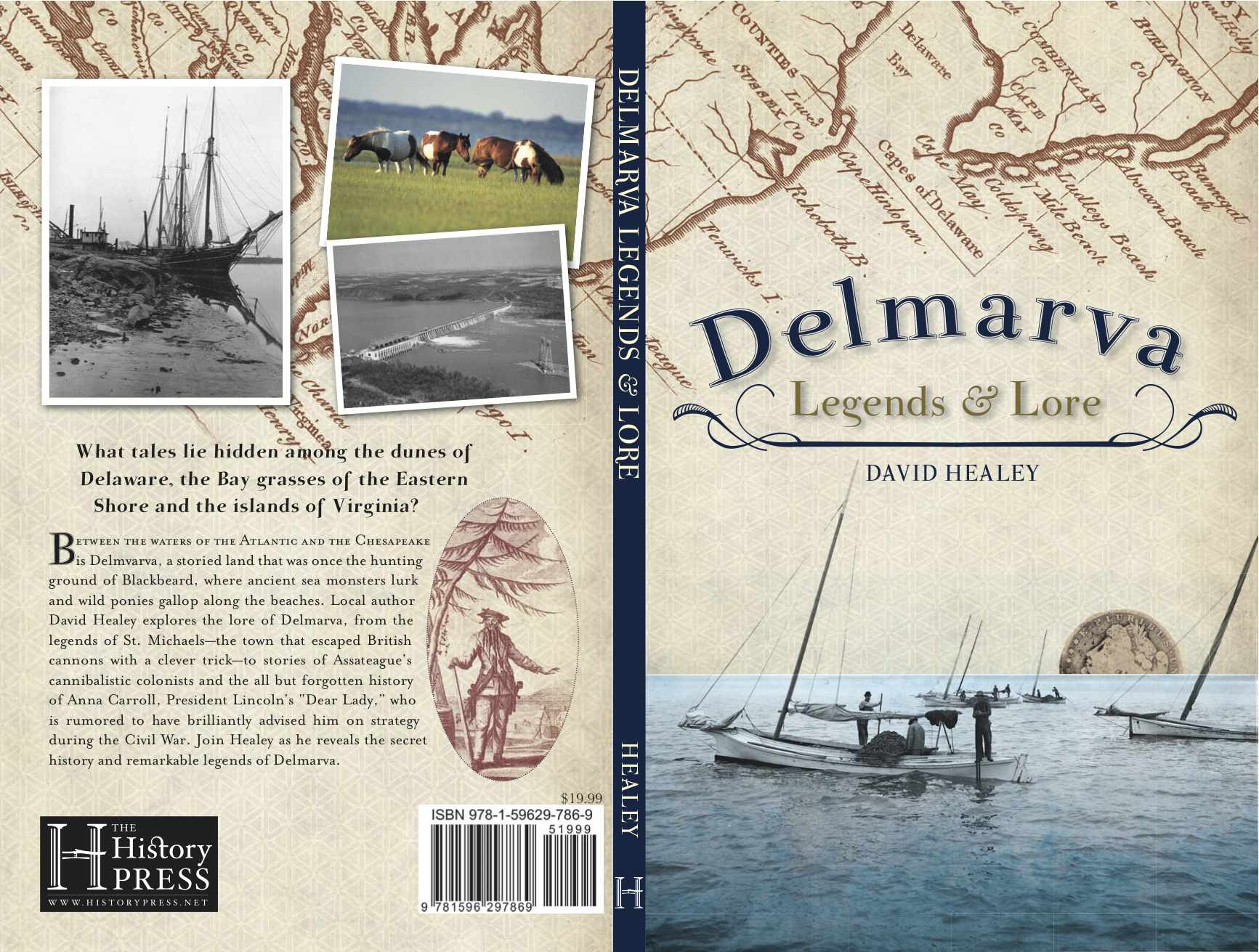
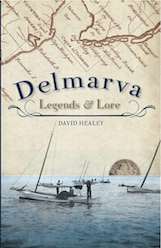
Delmarva Legends & Lore now an eBook!

Here’s a little something to put on that Kindle or Nook you got for Christmas … an eBook version of Delmarva Legends & Lore.

History Press made this title available recently as an ebook. Back last summer, they said they would be “experimenting” with ebooks and I let them know I hoped my book would be one of the titles they tried. I don’t know if that request reached the right ears or not, but in any case, it’s now available (including the photos!) as a digital book.

I haven’t quite put my finger on it—I’d say it’s irony, but not quite—in having a book that focuses so much on regional history now available in a digital format. So much of the research involved looking through long-out-of-print books and old newspapers and the like. Dusty, musty work. Or simply listening to stories handed down through old local families. And now it’s all available in nice, bright pixels.

For the record, I really enjoyed working on this book because I learned about so much “legends and lore” on the Delmarva Peninsula that was new to me … even as a lifelong Marylander. I’ve given several talks about the book up and down Delmarva (that unique land between the Chesapeake and Delaware bays), and I’ve been pleasantly surprised that others are just as delighted to learn these amazing bits of legend that have been overlooked through the years.

One of my favorite legends had to do with Charles Dickinson, the member of the landed gentry from Caroline County who set himself up as a planter in early 1800s Tennessee—what was the frontier at that time. It was a life filled with whiskey, plantations, horse racing … and duels.

Dickinson was a notorious duelist who killed as many as 20 men … but he met his match in none other than Andrew Jackson. Jackson nearly died (Dickinson was a crack shot) but not before delivering a mortal shot to the Marylander.

It’s just one of the many amazing stories from Delmarva’s past that we’ve somehow forgotten, but which have now been brought to light to share in the “digital era.”


Posted in Delmarva History, News and Events | Tagged , , , | Leave a comment

Upcoming Events! Speaking on the Civil War and War of 1812

Here are a couple of programs history buffs may be interested in, and which I happen to be leading or participating in …

The first is the Book Discussion and Program “Crossroads of Freedom” at the Elkton Library on Wednesday, Jan. 11 at 7 p.m. 

Antietam: Crossroads of Freedom While Gettysburg gets more attention as the decisive battle of the Civil War, for Marylanders the biggest clash came at Antietam in September 1862. In his book CROSSROADS OF FREEDOM, James M. McPherson examines the politics and personalities leading to the battle near the western Maryland town of Sharpsburg. During this discussion of the book and battle, we’ll also look at Antietam’s impact on the homefront here in Cecil County, where residents waited expectantly for word about husbands, fathers and brothers who were among the more than 26,000 dead and wounded.

The second is an Opsail Virginia 2012 lecture on Thursday, Jan. 19 from 7-8 p.m. at the Virginia Arts Festival Theater in Norfolk, Va. I’ll be speaking on the topic “Heroes and Villains of 1812.” This promises to be a great event!

They’ve provided this press release:

NORFOLK, VA — From November 2011 to May 2012, OpSail 2012 Virginia will host world renowned authors for a series of lectures on the War of 1812. In partnership with the U.S. Navy, OpSail 2012 Virginia is a bicentennial commemoration event for the War of 1812 and the writing of the Star Spangled Banner. The lectures will kick off OpSail 2012 Virginia activities, culminating in June 2012 when the Port of Virginia will once again host an impressive fleet of tall ships, navy and military war ships representing the world.

The OpSail 2012 Virginia 1812 Bicentennial Speaker Series will host seven acclaimed historians who will discuss Virginia’s role during the War of 1812 as well as major themes of the conflict.

Ian Toll, “Six Frigates and the Founding of the U.S. Navy” Spencer Tucker and David Healey, “Chesapeake-Leopard Affair” and “Heroes and Villains of the War of 1812”

Brian Lavery, “In Nelson’s Shadow: The Royal Navy in 1812”

Donald R. Hickey, “Myths of the War of 1812”

Catherine Allgor, “Dolley Madison and the Creation of the American Nation”

Walter R. Borneman, “Forging a Nation: Why the War of 1812 Matters”

Each lecture will begin with a 45 minute discussion by the author followed by 15-20 minutes for questions and audience participation. Following the lecture, there will be a reception and the opportunity to meet the authors. There will also be a drawing at each event for a one-of-a-kind gift set of autographed books from all seven featured historians. Interested parties can reserve their place for any of the six lectures at or email opsail2012virginia@festevents.org a minimum of one week before the lecture.

All events are free and open to the public; however, space is limited and reservations are required. OpSail 2012 Virginia is partnering with six community organizations to offer lectures at a variety of venues. Preceding the lecture, each venue will offer a preview of their 2011-2012 programs as well as information about OpSail 2012 Virginia.

Partners include the Chrysler Museum, Hampton Roads Naval Museum, NAUTICUS, Norfolk Botanical Garden, Tidewater Community College’s Roper Theater, and the Virginia Arts Festival. During the War of 1812, Virginia saw hundreds of small skirmishes and several important battles.

Posted in News and Events | Leave a comment

Novelist headed for the White House?

It’s been a while since we’ve had a real writer in the White House. Several presidents and vice presidents (and first ladies) have gone on to write best-selling memoirs, usually after they have left office. Naturally, Americans are curious about what really went on inside the Oval Office.

With Newt Gingrich now continuing to surge in the polls, it’s just possible we might be in for the novelty of having a fiction writer as president.

The last real “presidential”  writer we’ve had was Theodore Roosevelt.Roosevelt was the author of 18 non-fiction books, including HISTORY OF THE NAVAL WAR OF 1812. He also was an admirer of poetry (though he apparently didn’t write verse himself) to the point that his ability to quote poems from memory impressed none other than Robert Frost. Before venturing into politics, Roosevelt supported his large family as an editor and author.

Another world leader known for his writing was Winston Churchill. After leaving office, it’s said that he turned down requests to have books written about him because (and I’m paraphrasing here) “If there’s any money to be made writing about me, then I’m going to make it.”

Ulysses S. Grant was never known as a writer, but his MEMOIRS written while ailing with cancer (and published with help from Mark Twain) were an act of heroism as much as a literary endeavor.

Beyond the oval office, more than a few members of Congress and other political figures have been writers. The Civil War general Lew Wallace penned the best-seller BEN HUR back in 1880 and went on to become governor of the New Mexico Territory.

More recently, Congressman Robert Mrazek (now out of office) has published Civil War novels such as STONEWALL’S GOLD and UNHOLY FIRE.

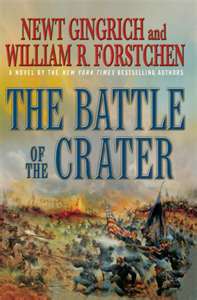
I’m not as familiar with the novels by Newt Gingrich (which have a co-author) but I plan on seeking out his books in the next few weeks. On my list will be THE BATTLE OF THE CRATER and TO TRY MEN’S SOULS (a novel of George Washington).

Whether or not one agrees with Newt Gingrich and his politics, it’s interesting to think that just by being a candidate he calls a bit more attention to writing … never a bad thing no matter which side of the aisle you’re on.


Posted in Writers & Writing | Tagged , , , | Leave a comment

Mixing fantasy and history for a new story

I’ve been working on a more fanciful piece of fiction right now, one that features gryphons. Pretty different for me as a writer, though I’ve always been a fan of fantasy and sci fi that turns real events on its head with an alternative take on history.

I’m certainly not inventing these mythical creatures out of whole cloth, but there is so much room for invention when one is writing about a creature (inserted into the more realistic, historical world) that does not actually exist. Frankly, it’s a lot of fun.

But introducing a creature such as the gryphon isn’t all that easy. Just for starters, how do you spell it? Griffin or gryphon? I like the second spelling because it seems more classical somehow.

There’s been a lot written about gryphons (though not nearly so much as about dragons or unicorns or zombies) but no one seems to agree—not exactly—on the qualities and traits of a gryphon. While it’s generally accepted that a gryphon is a cross between a giant eagle and a lion, resulting in the wings and head of an eagle and the claws, hindquarters and tail of a lion, one artist’s conception varies very much from another’s.

There is also the matter of size. Is a gryphon a smallish creature the size of a German Shepherd, or something much bigger? In my story, the gryphons are big enough to carry a rider, so that makes them roughly the size of a horse.

It seems that the myth of the gryphon comes from real life … sort of. The bones of winged dinosaurs were explained away by early scientists as being gryphon bones. Their lair was believed to have been mountainous areas—which is where those fossilized bones were first found.

But what about the nature of a gryphon? Walking our dog gives me time to think about that and compare the personalities of my made-up gryphons to my pup. Are gryphons loyal like dogs and protective? Our dog is friendly enough, but walk into the house unannounced and he’s quite the opposite. Or are gryphons more like horses in that they allow other people to ride them? It seems like a small question, but it’s so central to a good story.

And what of the intelligence of gryphons? They surely can’t read or write or reason. But I think they would have a certain animal cunning. Imagine being lost in the winter woods with a pack of wolves on your trail. You are smarter than a wolf and perhaps can recite poetry or play the guitar or do your own taxes. But in the woods that’s not much use, and wouldn’t you say that a hungry wolf has a clear advantage in tht environment? The same might be said of gryphons … not smart or rational like humans, but very dangerous opponents in certain situations. Or useful allies.

In the end, there is a lot of discovery about characters—real humans and mythical creatures—that takes place on the page. But that’s part of the thrill of writing a story, isn’t it? Or reading one, for that matter.


Posted in Writers & Writing | Tagged , , | 2 Comments

Where the ghost stories come out to play

From this stairwell window, it’s likely several hangings were viewed in the jail yard below.

With its colonial history and old brick streets, it’s no surprise that the town of Elkton, Maryland, at the top of Chesapeake Bay, is wickedly haunted. And on an October night flecked with stars, we wanted to see if the ghosts would come out and play.

We weren’t disappointed.

Around sixty people took to the streets for this Ghost Walk sponsored by the Cecil County Arts Council and the Historical Society of Cecil County. Some came with devices  to measure electromagnetic fields, or if nothing else, digital cameras to detect the auras or orbs left behind by a spiritual presence. Wandering the streets at night, one almost felt just like a ghost because the downtown was mostly deserted.

One of the more spooky destinations was the Old Jail. Built in the 1870s, this substantial granite-walled structure on North Street housed prisoners until the new detention center on Landing Lane opened in the 1980s. The county-owned building is now empty, so that the ghosts pretty much have the place to themselves.

CURIOSITY OF THE DAY: Ghost hunting equipment.

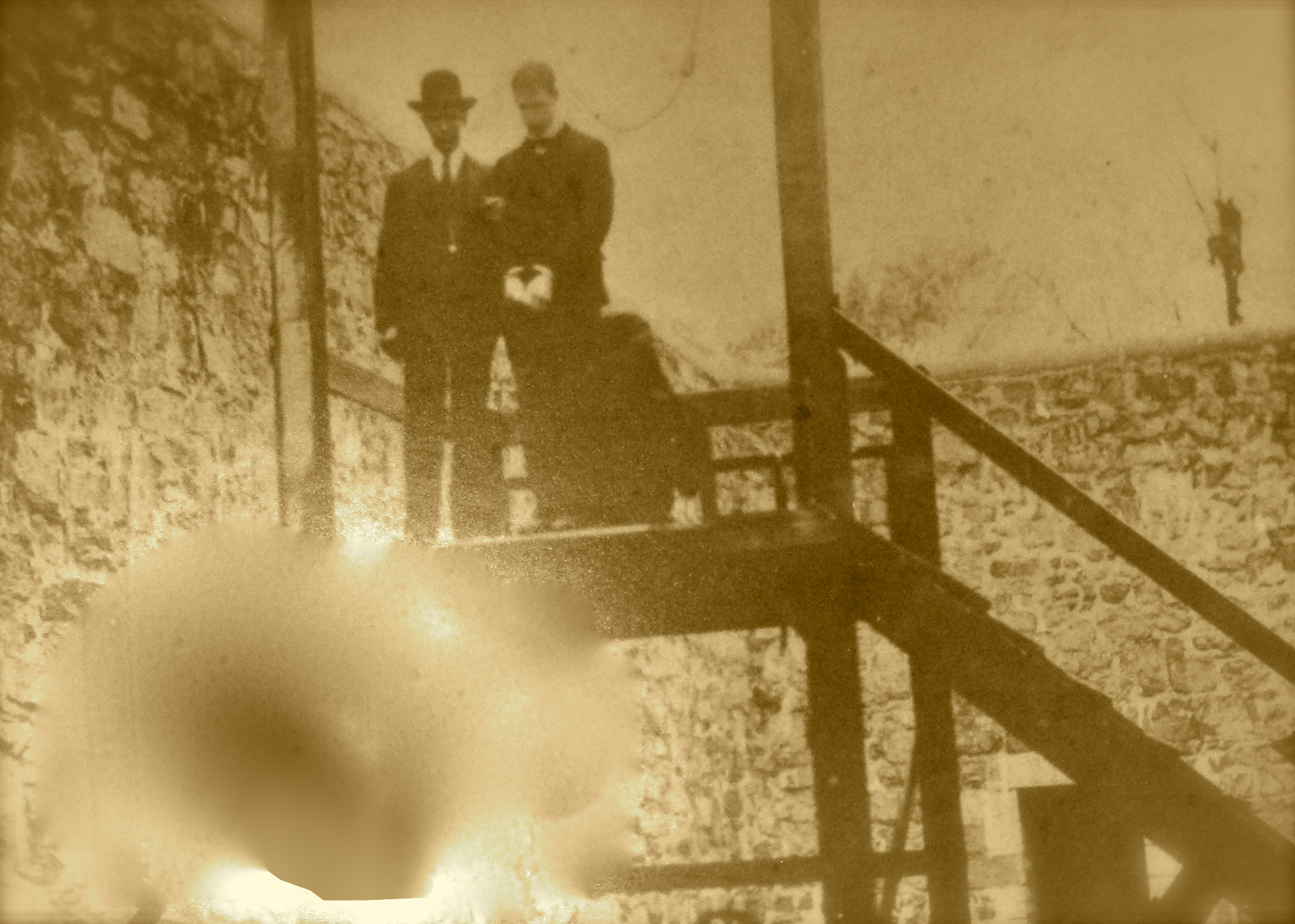
As the group stood in what was once the jail’s exercise yard, local historian Mike Dixon noted that at least five hangings had taken place there. The last was in 1905, when a man guilty of murder climbed the scaffold for a date with a noose. In those days, Dixon explained, it was the county sheriff’s job to carry out the hangings. It was a spectacle that attracted a crowd of hundreds, if not thousands, to the county seat.

Such gruesome punishments resulted in more than a few ghost tales. Allegedly, inmates in more recent years sometimes heard inexplicable sounds of hammering and sawing … echoing the noise of gallows being built.

Accompanying the group were members of Cecil and Beyond Paranormal … a group of local ghost hunters. At least one member reported seeing a “dark figure” approach in the cellar of the Old Jail, along with a feeling of “angst” or sadness. When you think of all the broken lives that ended up in the County Jail, it’s no surprise that a spirit or two may linger, still imprisoned in the empty, vaulted cellar after all these years.

The creepy jail cellar that once held cells for the worst prisoners.

Time to ‘fess up here … I’ve never seen a ghost, nor do I particularly believe in them. I do like the historical side of the ghost stories and the storytelling involved, and that’s where it ends for me. But at that jail, I felt chills. There was definitely something in the air—call it an atmosphere or an energy. It felt sad and creepy all at once, and I was glad to leave. Some poor souls must still linger in the confines of the old granite walls.

Another stop on the Ghost Tour of Elkton was the Howard House, built in about 1844. The owner reported inexplicable noises and a sense of “not being alone.”

And then there was the Mitchell House on Main Street, where Dr. Mitchell treated wounded soldiers during the Revolutionary War. Some were Redcoats and some were Colonials. Those who didn’t survive were likely buried in unmarked graves on the grounds. It’s no wonder that the Mitchell House has its share of ghostie stories. It’s just one of many spooky locales in downtown Elkton, a town that has accumulated its share of ghosts and ghost stories in the past 250 years.

The last hanging at the county jail in 1905. The sheriff gave out tickets.

Posted in Delmarva History, News and Events | Tagged , | Leave a comment

How my Apple taught me to write

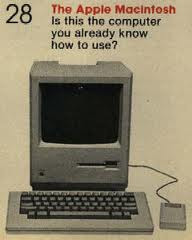
One of the original Apples. I wish I had a photo of the one I used. But heck, that was before digital cameras. COURTESY CONSUMER REPORTS.

The passing of Apple CEO Steve Jobs was sad news that we discussed around the dinner table … not in the morbid sense, but mainly because we found his life story  to be so inspiring. I had just been reading about Jobs in Thomas Friedman’s new book, “That Used To Be Us.” He was a great role model for the kind of innovative thinking and entrepreneurship America needs in the 21st century. I suppose you don’t have to invent the next iPod, but any sort of business or artistic endeavor can benefit from his brand of fearlessness.

But what I really wanted to talk about was Apple computers as tools for writing. You see, it always comes back to writing, doesn’t it 😉

Back a long, long time ago I used to type my final short story manuscripts on an electric typewriter. The problem, of course, was that the smallest change to a word or a simple rearranging of a sentence meant laboriously retyping the entire manuscript. Hello Whiteout! There were all sort of tricks, though, where I might squeeze an extra line or two onto the retyped page to avoid retyping the whole story … or maybe cutting a line or two to make the page “fit” into the rest of the story.

The result was that a typed story had a finality to it, almost like being carved in stone. At least it felt that way to a teenaged writer!

When I started college in 1985, I brought that electric typewriter along with me. I can’t remember typing any papers on it, but I did use it to bang out my first article for The Elm as I sat in my dorm room in Kent Hall.

But that was probably the last time I ever really used a typewriter. Washington College had a partnership with Apple to introduce Macintosh computers to campus. There were two set up in the Lit House and from then on, everything I wrote was on an Apple.

It was incredibly liberating. I could move paragraphs around, delete sentences, add in a few words. Then print it all out on a dot matrix printer. The result didn’t look as “serious” as a typewritten sheet, but neither did the words feel engraved in stone.  Writing was now a maleable process. It made me less afraid to tinker or rewrite what I’d written.

If you’ve worked on a MacBook or MacAir, those old Apple computers seem a world away. They were cubes with clunky keyboards and no built-in memory. No color screen. You needed to bring your own start-up disk with MacWrite on it, and then have another disk handy to actually store your words. These computers were tools, and when you sat down in front of one, you wrote.

No video, no music, no Internet. That was all a decade away. Just you and the words and maybe a cup of coffee or a cigarette if you were so inclined.

These original Apples were very expensive. I saved up and bought one after I graduated and got my first job as a newspaper reporter. For what I paid for this very basic computer, today I could have a really, really top-of-the-line machine … or a nice down payment on an Acura. But it was worth every penny. It was on my first Apple, liberated from having to write English papers or from waiting for someone else to be done with it, that I really learned to write.

Maybe there were other PCs around, but it was really my Apple that made being a writer possible for me.

It may come as no surprise that I’m writing this today on a MacBook. It’s a beautiful machine, but if I had to give it up for one of those old 1985 Apples I wouldn’t fret too much. Sure, I’d miss all the bells and whistles. But I’d feel right at home as a writer.

Posted in Writers & Writing | Leave a comment