From the July issue of The Big Thrill: Earthquakes and a tsunami in this eco thriller

Cascadia by H.W. Bernard

CASCADIA FRONT COVER 4_1By David Healey

H.W. “Buzz” Bernard has just the sort of resume you might expect from an author of weather-related disaster thrillers. He has a degree in atmospheric science, spent a career in the Navy as a weather officer, was a senior meteorologist for The Weather Channel, and has gone in search of tornadoes with professional storm chasers. He has even flown into a hurricane aboard a hurricane hunter, an experience that helped prompt his best-selling thriller, Eyewall.

Now, Bernard has decided to shake things up.

Literally.

His newest novel is CASCADIA, set in the Pacific Northwest town of Manzanita. The plot focuses on Dr. Rob Elwood, a geologist who makes a startling prediction. Not only will a cataclysmic earthquake strike the region once again, but the event will be followed by an epic tsunami. Elwood knows this from his study of the geological record, which indicates that another “big one” is on the way.

Elwood puts his career, and even his marriage, on the line by making a very specific prediction: disaster will strike the Cascadia Subduction Zone over the busy July Fourth weekend.

The scariest part of the story may be that Bernard’s book, like his others, is based on fact.

“I try to stay within the realm of possibility,” Bernard explained.

Much of CASCADIA is based on current geoscience, he said, which points toward a natural disaster much like the one imagined in those pages.

“Unfortunately, that is a worst-case scenario that is going to happen someday,” he said. “When it happens, it’s going to be the worst natural disaster in the United States.”

For someone who has written several novels about super storms and natural disasters, Bernard is far from an alarmist. However, he does say it helps to be prepared for disaster. After all, the best time to fix the roof is when the sun is shining—or in this case, before the earth starts quaking.

“At least be minimally prepared for when it hits,” he said.

One of the really fun aspects of CASCADIA is a subplot about the hunt for treasure on Neahkahnie Mountain. This well-known Pacific Northwest legend purports that treasure buried by Spanish explorers in the late 1500s lies buried somewhere on the mountain.

“That mountain has been dug up from top to bottom,” Bernard said. “As far as I know, nobody has reported finding treasure on the mountain.”

(Then again, who would report finding the treasure?)

Bernard got his start as a fiction writer after authoring several successful nonfiction weather books.

When he started, “I just sat down and wrote—how hard could this be?”

Pretty hard, as it turns out.

An encounter with best-selling thriller author Steve Barry at a conference in 2005 was a particularly humbling experience.

Bernard went into a one-on-one manuscript review session with high expectations. He was sure the novel would inspire awe and excitement. Maybe Barry would even recommend his agent!

But after reviewing the first 10 pages and synopsis, Barry handed them back with the words: “You’ve got a lot of work to do.”

“I don’t think I heard anything else he said. I was just crushed,” Bernard said.

That’s when Bernard got serious about learning the craft of thriller writing.

“That’s why you go to these conferences. You go to learn.” Also, there are many personal connections, and encouragement. “It keeps you going as a writer.”

His advice?

“You have got to learn the craft. That’s why the Southeast Writers’ Association was so valuable to me. I went to seminars and had people discuss the craft of writing. You’ve got to learn the craft.”

As the lessons sink in from attending workshops and seminars, he said, you can begin to pick and choose advice based on what works for you: “You kind of develop your own style that way.”

After 10 years of learning the craft, and four different manuscripts, his personal “perfect storm” arrived with Eyewall.

He is now taking the reins as president of the Southeastern Writers’ Association, the organization that was so helpful to him in learning to become a thriller writer.

“I attribute a lot of my success to them,” he said.

In addition to running the writers’ organization, he is busy marketing and promoting CASCADIA. These days, his writing schedule is flexible, and he carries his shih tzu upstairs to keep him company in the office.

“I don’t keep a hard and fast schedule,” he said with a laugh. “I’m supposed to be retired!”

*****

buzzH. W. “Buzz” Bernard is a best-selling novelist, retired Weather Channel meteorologist, and a USAF veteran.  His debut novel, EYEWALL, was released in 2011 and went on to become a number-one best seller in Amazon’s Kindle Store. His next two novels, PLAGUE and SUPERCELL, won EPIC eBook Awards in the suspense/thriller category. His fourth novel, BLIZZARD, led to his nomination as a 2016 Georgia Author of the Year. CASCADIA, his most recent thriller, will be released in July 2016.

Buzz has penetrated the eye of a hurricane with the Air Force Hurricane Hunters, chased tornadoes, and provided field support to forest fire fighting operations in the Pacific Northwest. He also spent a summer working on Alaska’s arctic slope, and served two tours in Vietnam while on active duty with the Air Force.

He’s native Oregonian but now calls Roswell, Georgia, home. To learn more, please visit his website.

You can read the original article (and a lot of other great articles) in the July issue of The Big Thrill, published by the International Thriller Writers.

Posted in Writers & Writing | Leave a comment

Meet Ben Blackshaw and Robert Blake Whitehill

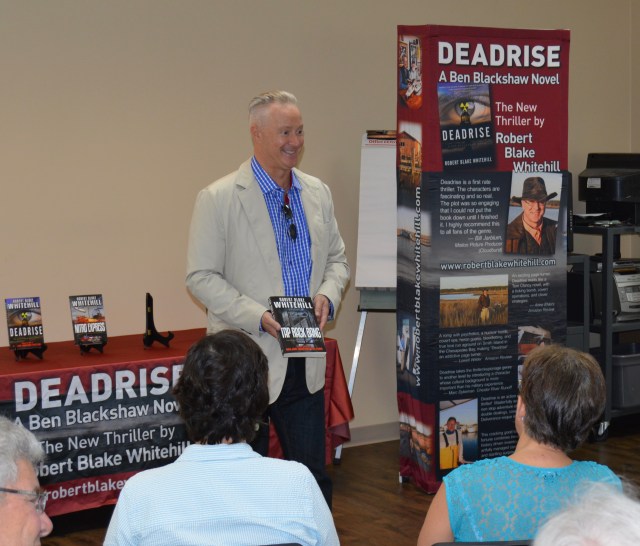
Robert Blake Whitehill speaking with other writers at the Queen Anne's County Library.

Robert Blake Whitehill speaking with other writers at the Queen Anne’s County Library.

Thriller author Robert Blake Whitehill was the speaker at Saturday’s gathering of Eastern Shore Writers. Robert shared his own success story with writing and publishing his Ben Blackshaw series, which has not only been a hit with readers, but has been optioned for film and is currently in the development process.

Whitehill grew up in a Quaker family in Mardela Springs (Wicomico County) but now lives in Montclair, N.J. Those Eastern Shore roots tugged at him in creating and writing his novels.

Earlier in life, he didn’t set out to be a writer, but an actor. However, he soon found a knack for writing personalized audition monologues for other actors, and then screenplays. He even found a gig writing for the “True Crime” TV series.

Both were good training grounds for how to write action and emotion: “For the monologues, whatever made them breathe faster and brought color to their cheeks, that was the subject of the monologue.”

For many years, Whitehill also worked on the ambulance crew in Montclair, which was a real eye opener into the many facets of how people really live—and die.

“Any experience you give yourself like that is tremendously helpful,” he said.

But the ambulance work took its toll emotionally and physically—hauling stretchers up and down staircases isn’t easy on a back—and he turned his attention to writing fiction. The result was his first Ben Blackshaw novel, “Deadrise.”

Blackshaw is one of those characters in the vein of Jack Reader or Travis McGee. And while McGree in particular is associated with Florida, Blackshaw is a Chesapeake Bay man.

Whitehill got to the core of his character: “If he learns of an injustice, he has to set it right. He is outside the firelight and working in the shadows, for good or ill.”

To help him in writing the books, Whitehill has assembled a team of experts on everything from firearms to the “emotional truths” of combat veterans to editing and cover design.

One unusual tip he suggested for writers is that they take a class in improv comedy. “It will take the stiffness and formality out of the dialogue you write,” he said. “Also, it will help you find your inner funny person. We all have one of those.”

The next step for the Ben Blackshaw character may very well be to the big screen. The stories are currently in the development phase, with the author taking time out to work on the screenplays. While a movie would definitely bring Ben Blackshaw to a wider audience, for now there are four popular novels where the character leaps off the pages.

Whitehill said his goal is for the reader to be entertained on every page.

“If a reader is going to give that time to me, I’m going to respect that to the utmost,” Whitehill said.

Posted in Writers & Writing | Leave a comment

Latest from The Big Thrill

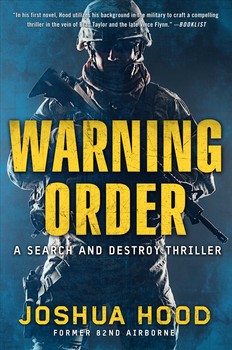
Warning Order by Joshua Hood

By David Healey

warning-order-9781501108280_lgJoshua Hood may be a relative newcomer to the ranks of published authors, but he is one of those rare thriller writers who has lived more than a few of the experiences described in his military fiction.

Jumping out of airplanes? Check.

Duty in Iraq and Afghanistan? Check.

Combat experience? Check.

He served with the 82nd Airborne for five years, which included missions in Iraq and Afghanistan. He was decorated for valor in Operation Enduring Freedom in Afghanistan. Now out of the military, his day job still involves its share of excitement as a full-time member of the Memphis SWAT team.

Even while living the life of a thriller character, he never gave up on wanting to be a storyteller.

“I’ve always wanted to be a writer,” he said in a recent interview. “Very early on I developed this love for the written word. Being from the South, I think we’re all kind of natural storytellers.”

In WARNING ORDER, protagonist Mason Kane and other covert operators are in Syria, battling ISIS operatives. It is hard to know who to trust and where loyalties lie. This seems to be true among the American military operatives as well—the plot twists will keep readers off balance. Bullets fly off the pages of the urban combat scenes, described in graphic detail with the accuracy of someone who has been there. It’s worth noting that Kane has a particular skill with a custom-made combat knife.

The action is fast-paced, realistic, and tells a story that begins where the headlines end.

“There is no clear path to victory,” the author noted of the real-life situation.

At the same time, he wanted to create authenticity in his writing and pay homage to the soldiers who are fighting these battles today.

Josh-Hoods-desk

The writing desk that Joshua Hood built for himself and where he is now writing his military thrillers.

“I wanted Mason Kane to be as realistic as possible,” he said. His character  can have a hard time readjusting to “normal” life after a violent mission. “It’s kind of a dark place to go, but there are people out there who have shared this experience. To paraphrase Nietzsche, ‘If you spend enough time hunting monsters, you become one.’ ”

Growing up, he read anything he could get his hands on, thanks to a library card and a family that encouraged reading. Before joining the military, he was an English major at the University of Memphis.

The first thriller he read (if you don’t count The Iliad and The Odyssey, The Three Musketeers, The Count of Monte Cristo, and The Scarlett Pimpernel, all of which he read as a kid) was Eye of the Storm by Jack Higgins. “He is so good at taking these things that happened (such as the IRA mortar attack on Number Ten Downing Street) and building a story around them,” Hood said.

Drawing on an amazing knowledge of military history, Hood makes these same connections with current events. He posits that the current war on terrorism is repeating a cycle of conflict that began as far back as the Crusades.

The books he read in his youth, and his experiences in the military, have been encouragement to write his own thrillers. Before his new book, WARNING ORDER, there was Clear by Fire. He said that he learned a lot about the craft of writing with that book, particularly the need to create at least a rough outline of where the story is going.

“If I don’t know where I’m going I tend to get lost,” he said. He also carries a notebook to jot down ideas.

“Writing is a lot like golf,” he said. “Just when you think you’re good at this, you go out and have a terrible day.”

Hood said he has focused a lot on improving his craft as a writer, particularly because he wants readers to have a great experience with one of his books.

“I’m making a contract with every reader,” he said.

His efforts are being noticed. One of the bestselling authors who provided a blurb for WARNING ORDER was Ted Bell, who is no stranger to action and international intrigue in his own bestsellers. Bell wrote: “There are the guys who’ve been there, and the guys who haven’t. Joshua Hood’s been there, and it shows on every page. Helluva fine writer.”

Such praise set Hood’s head spinning. “It’s still a daydream,” he said of his writing success.

It also turns out that the particular skill set of this 36-year-old, polite and soft-spoken author includes woodworking. Before he settled down to write, he built his own desk from scratch.

“In my mind, it’s all about being a craftsman,” he explained. “I have a connection not only to what I’m writing, but what I’m writing on. It’s like a grounding principle.”

*****

Joshua Hood graduated from the University of Memphis before joining the military and spending five years in the 82nd Airborne Division, where he was team leader in the 3-504 Parachute Infantry Regiment. In 2005, he was sent to Iraq and conducted combat operations in support of Operation Iraqi Freedom from 2005–2006. From 2007 to 2008 he served as a squad leader in the 1-508th Parachute Infantry Regiment and was deployed to Afghanistan for Operation Enduring Freedom. Hood was decorated for valor in Operation Furious Pursuit. He is currently a member of a full time SWAT team in Memphis, Tennessee, and has conducted countless stateside operations with the FBI, ATF, DEA, Secret Service, and US Marshals.

To learn more about Joshua, please visit his website.

Posted in Writers & Writing | 2 Comments

Some thoughts on the messy process of writing

On the blog of the always interesting Jane Friedman, author Stuart Horwitz has a good post about the drafting process of writing a book. Stuart suggests writing a draft in three stages—basically a rough draft, a draft in revision, and a polished or “edited” draft. This is just the process that has evolved for me after writing more than a dozen published books.

However, it’s not as easy as 1, 2, 3. It’s more like cooking dinner. Sure, that can be broken down into three steps: prepare the ingredients, cook, eat. But somewhere in there you have to shop for the ingredients and try not to overcook the fish. And set the table. Open the wine. Writing is a lot like that—a process with myriad mini-steps to get things just right.

For anyone interested in how writers write, the thriller author Steve Berry has some good videos on YouTube about his own writing process. He states that he goes through the manuscript about 60 times … that sounds about right to me. That’s not actually reading the book from start to finish each time, but focusing on different areas of the draft, taking it from a mess to something that readers will enjoy.

Berry also talks about how much thinking goes into a book. First, I agree that it helps to have a rough idea of the whole story in your head. Before writing, it is useful to think through each scene, often by brainstorming on paper. Even better is to do this the day before so that you spend your precious writing time actually writing.

And let’s not forget research! For writers of historical fiction, that will involve lots of reading and maybe some travel, studying period photographs, or handling actual artifacts when possible to get the details just right. You will also need a good pen to get writing.

The process of writing a book is probably interesting only to other writers, and not so much to readers. Suffice it to say that writing is a messy and fascinating process that gets the story in your head down on the page. It’s as easy, and as hard, as that 1, 2, 3!


Posted in Writers & Writing | Leave a comment

Inside the Seal Team Six series

Recently, I had the chance to interview Ralph Pezzullo, who writes the popular SEAL TEAM SIX series. Ralph is a real pro who is equally comfortable discussing writing or world politics. The interview follows, and you can read the original (along with many other great author interviews) over at The Big Thrill.

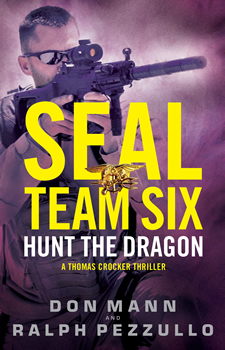
Hunt the Dragon by Don Mann & Ralph Pezzullo

By David Healey

Hunt-the-DragonWhen it comes to dealing with the trouble spots of the world, the United States government must have Seal Team Six on speed dial.

In SEAL TEAM SIX: HUNT THE DRAGON, the newest novel featuring Navy SEALS from the writing team of Ralph Pezzullo and Don Mann, the main character, Thomas Crocker, goes from Russia to Las Vegas and finally to a deadly covert mission to North Korea.

Although HUNT THE DRAGON is a work of fiction, it’s built around the very real missions of SEALS all over the world. These covert operators take over where diplomacy ends and direct military action would be out of the question.

“I wanted to give some sense of how busy these guys are,” said Pezzullo, a California-based writer of fiction and nonfiction. “There is a lot of animosity in the world. We think it’s all in the Middle East but there are a lot of hotspots.”

He asked one of his military acquaintances just how busy he was, and the reply was that the SEAL had spent 300 days deployed in the previous year.

Some SEALS are running 40 missions a year, which is reflected in how busy Crocker is in the novel, pinballing from Eastern Europe to Vegas to North Korea.

“Because of the nature of the wars today they rely a lot more on these special operations teams,” Pezzullo said.

To be sure, there is no shortage of trouble spots. Pezzullo, whose father was the U.S. ambassador to Nicaragua in the 1980s, grew up around some of them. One continuing trouble spot is the Middle East. “It’s a mess,” he said. He considered the failed governments, poverty, and soaring unemployment of young men “perfect fodder for ISIS.”

Not to mention perfect fodder for thrillers. One of the SEAL TEAM SIX thrillers, Hunt the Scorpion, is set in Libya.

For HUNT THE DRAGON, Crocker and his team head to North Korea. The country—described in the pages as a place where, among other things, disloyal government officials are torn to pieces by starving dogs—seems too brutal to be real.

“That’s all true. They are weird. It’s a very strange country. It’s a dangerous country,” Pezzullo said. “It’s a very bizarre totalitarian regime.”

Needless to say, it takes a special person to become a SEAL.

According to the U.S. Navy, SEAL is an acronym for Sea, Air, and Land—defining their areas of operation, which seems to be all encompassing. The basic physical fitness test to be considered includes being able to swim 500 yards in 12 and a half minutes, immediately followed by 50 pushups, 50 sit ups, 10 pull ups, and a 1.5 mile run in 10 minutes and 30 seconds.

Feeling tired yet? It’s small wonder that there are just around 2,500 active duty SEALS.

Those are just the paper requirements for physical fitness. Pezzullo pointed out that these men are very smart, and often have a working knowledge of several languages. They aren’t the typical “clean cut” Navy poster boy. Tattoos and beards aren’t uncommon. And while they are very fit, they aren’t necessarily physically imposing at first glance.

“They would blend into a crowd.” He added, “They love this kind of stuff. They’re adrenalin junkies.”

Crocker’s personal life mirrors the complicated lives of many of these special forces operators, having to shift from warrior mode and back to being a husband or father. It’s not always easy.

“There’s a huge personal sacrifice that these people make,” Pezzullo noted.

Interestingly, there is a deep emotional aspect to these SEAL TEAM SIX books. Pezzullo said that mirrors the connection that these SEALS have to their comrades-in-arms.

“These are human beings,” he noted. “They’re not robots. They’re not cold-blooded killers.”

Pezzullo has written nonfiction books about the region and about special ops. He noted that when it comes to research, “One side feeds the other. With the thriller scenario, I try to keep it as real as possible.”

For expertise into SEALS, Pezzullo relies on his writing partner, Don Mann, a former SEAL.“Don Mann is one of greatest guys I’ve ever met,” Pezzullo said. “Crocker is pretty close to Don.”

Their method is that they develop the stories together, with Pezzullo being the actual writer. Mann “keeps it real” by giving feedback on the draft and answering questions on anything from tactics to equipment.  (It’s worth nothing that between books, Mann was heading out to climb Mount Everest.)

Writing thrillers and nonfiction books about men who work in the shadows and about military secrets can have its frightening moments. For Pezzullo, one of these moments came not while visiting a war zone (which he has done) or while witnessing a firefight (which he also has done), but right at home. While working on a nonfiction book about special operations, Pezzullo got a call warning him that his home was about to be raided by federal agents. The concern was that Pezzullo had been made privy to sensitive information that he was not supposed to have.

After several tense hours, the raid did not take place: “But that was scary!”

HUNT THE DRAGON is the sixth installment in the series, with two more books planned. Look for the SEALS to turn up in Nigeria and Kurdistan.

Pezzullo has been lobbying for a TV series based on the books, but that remains to be seen.

His other writing projects include a series set in New York, and several plays. In fact, he will soon be heading to London for the opening of his play, The American Wife.

“If you want to make a living at writing, you have to have a lot of things going,” he said.

*****

ralph pRalph Pezzullo is a New York Times bestselling author, and an award-winning playwright and screenwriter. His books have been published in over twenty languages and includeJawbreaker (with CIA operative Gary Berntsen), Inside SEAL Team Six (with Don Mann), The Walk-In, At the Fall of Somoza, Plunging Into Haiti (winner of the 2006 Douglas Dillon Prize for American Diplomacy), Eve Missing, Blood of My Blood, Most Evil (with Steve Hodel), the SEAL Team Six thrillers Hunt the Wolf, Hunt the Scorpion, Hunt the Falcon, Hunt the Jackal, Hunt the Fox, and The Navy SEAL Survival Handbook (also with Don Mann), and most recently Zero Footprint.

To learn more about Ralph, please visit his website.

Posted in Uncategorized | Leave a comment

Historical fiction with a Boston setting

Here is the proposed cover for Jane Healey's novel.

Here is the proposed cover for Jane Healey’s novel.

My cousin, Jane, lives in the Boston area and is an accomplished magazine writer … she recently wrote a novel called THE SATURDAY EVENING GIRLS CLUB that is being “auditioned” through an amazon.com program called Kindle Scout. I guess you could call it crowd sourcing. You can read the first couple of chapters and then make comments or vote. At the end of the month, based on those votes and comments, Jane could get a publishing deal for her book, which is pretty exciting!

It’s very convenient to download those first two chapters to your Kindle right from the website, which I did, or you can read the chapters on your computer.

Wow, Jane really knocked this one out of the park with a well-drawn central character named Caprice (that name tells you something of her nature), conflict, and a fascinating historical setting with these young immigrant women as the main characters. Historical novels with a first person POV can be tricky to pull off because it’s not easy getting inside the head of someone who lived a century ago, but I think Jane has done just that here. It helps that she has done a lot of research into Boston history for her magazine articles.

This isn’t my usual sort of novel to read (What, nothing explodes! No shooting? No determined character facing an impossible mission? Come on now …) but the story really draws you in. It kept reminding me of “The Sisterhood of the Traveling Pants” set in 1908. (Hey, I happened to pre-screen that novel when my daughter wanted to read it way back when.)

Jane’s novel is set in 1908 Boston and presents an interesting connection between the high society ladies who generally hire the immigrant “girls” who are mostly Italian, Irish, and Jewish … in this case, the two groups discover they have much to offer one another. I’ve only read the chapters available on Kindle Scout, and I was very disappointed to arrive at the end of the sample. (Jane, send the rest of the novel ASAP!)

If historical novels are your thing, or just good novels, please consider giving Jane’s chapters a read and a vote!

https://kindlescout.amazon.com/p/QYTCZG66RLUY

Posted in Writers & Writing | Tagged | Leave a comment

Exploring Civil War Legends & Lore

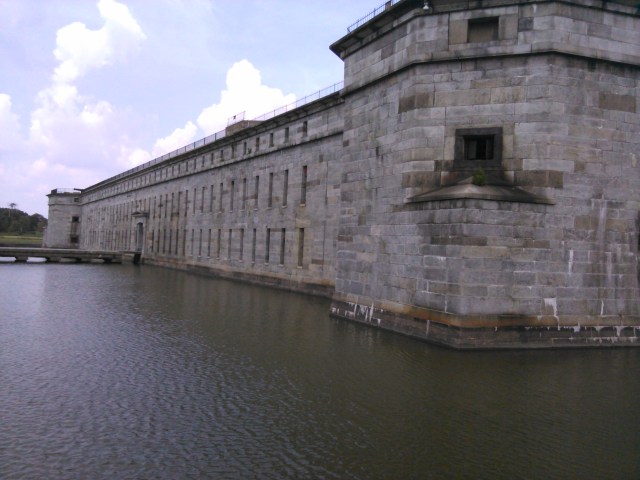
Fort Delaware generated its share of local legends as a POW camp for Confederate prisoners.

Fort Delaware generated its share of local legends as a POW camp for Confederate prisoners.

Most of us know the “greater story” of the Civil War—the battles, the politics, the leaders. We’ve heard of Grant and Lee, Gettysburg and Antietam, Abe Lincoln and Jeff Davis.

But it’s the “little stories”—the quirky ones about people and events–that make this time period so fascinating even today. Some of these tales of Civil War legend and lore are funny, some sad, but they all bring a very human side to the war 150 years later.

These stories will be the focus of “Civil War Legends and Lore” talk I’ll be giving at 6:30 p.m. Tuesday, May 10, at the Chesapeake City Branch Library in Maryland. We’ll classify these stories as “legends and lore” because local tradition and folklore have filled in the blanks between the known facts.

Our region has no shortage of Civil War legends and lore, much of it spiced up by the fact that Maryland residents had divided loyalties. Maryland was a border state, even though it is located south of the Mason-Dixon Line. In Cecil County and the rest of Maryland some residents were fiercely pro-Union; others were pro-Confederate to the point that they fled South to take up arms against the United States. Once war was declared, Cecil Countians, for the most part, supported the Union and its new president, even if they hadn’t necessarily voted for him.

Fort Delaware framedSome of the other legends and lore we’ll touch upon that evening:

  • How “mule skinners” took over the mansion and grounds at Perry Point, where the owners were pro-southern. The owners complained that Yankee officers banged up the elegant staircase with their swords.
  • The C&D Canal played a huge role in the early days of the war, enabling Lincoln to bring loyal troops from “up north” to occupy Maryland after Federal troops traveling by train were attacked in Baltimore. The nervous canal superintendent in Chesapeake City constantly feared attacks by Confederate raiders.
  • George Alfred Townsend spent his boyhood summers along the Bohemia River. The war made him famous as the newsman of his day who went on to be friends with Mark Twain. We’ll take a look at a story he wrote with a touch of dark humor about the topic of undertakers making their fortune after the battle of Antietam.
  • A newspaper editor whose pro-Southern editorial got him marched out of town at bayonet point by Union troops and locked up in Fort McHenry.
  • A Civil War romance that started when a Chesapeake City girl met a captured Confederate officer on his way to the prisoner of war camp at Fort Delaware.

As divided and cantankerous as the two sides could be here in Cecil County, one of the impressions that stands out is how people seemed to have put aside their differences after the war. It’s a lesson that shouldn’t be lost on us today as we struggle through sometimes divisive times of our own.

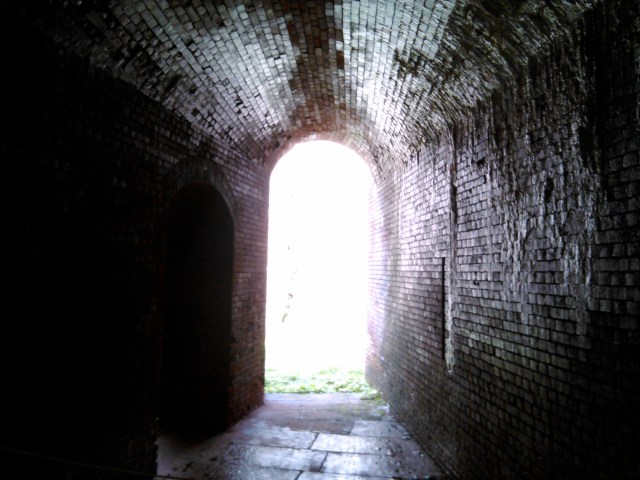
Some say that Fort Delaware is haunted. Now, why would anyone think that?

Some say that Fort Delaware is haunted. Now, why would anyone think that?


Posted in Delmarva History | Leave a comment

Big Thrill interview with Stefanie Ross

Nemesis: Innocence Sold by Stefanie Ross

NemesisBy David Healey

The first pages of NEMESIS: INNOCENCE SOLD by German author Stefanie Ross are filled with an extensive list of dramatis personae and it soon becomes clear why because there is so much going on in those opening chapters: drug raids, police department politics, an apparent abduction, and even the involvement of both German and American Special Forces. These seemingly disparate plots come together like a batch of holiday Glühwein made with warm red wine, spices, a little orange rind, and sugar. Take a sip—it’s a delicious winter cocktail, just as this is a delicious thriller.

With this novel, the author is finally making her first appearance to American readers after several popular novels in her native Germany.

In between visiting Germany’s famous Christmas markets and getting ready for the holidays, Ross answered a few questions about her 2016 debut for American readers.

One of the things that’s really interesting about NEMESIS: INNOCENCE SOLD is that while there is plenty of action, there is a lot of focus on male friendships between characters like Mark, Sven, Dirk, and Danny. These are tough guys, but they care deeply about one another. This is something that’s often glossed over in many thrillers. Can you talk a little about your insights into these male friendships?

Well, NEMESIS: INNOCENCE SOLD is the fifth part of this series, so there’s a history behind these men. They fought together, learned to trust each other, and know each other very well.

I love the male friendships in movies like Top Gun (Maverick and Goose) or Lethal Weapon (Riggs and Murdock), but thought about them as a “Hollywood thing.” When I started to research Special Forces and even talked to some members of a German unit, I learned that this kind of friendship is a significant part of their job. They have to trust each other and know exactly how their partner is acting and thinking. I’ve tried to show this in my books and it works. My readers love it and I’ve also heard from men in similar jobs that this part is quite realistic (even if the cases are fiction.)

You have published 15 novels in German and Bulgarian. NEMESIS: INNOCENCE SOLD is your first book to be translated into English. Did you take a different approach in this novel, knowing that it would be read by an American audience?

No, I wasn’t thinking about any translation when I wrote NEMESIS. The translation was done after the book was quite successful in Germany and a “No. 1 bestseller in thriller” on Amazon.

You have traveled quite a bit in the United States—even by motorcycle! What were some of your favorite places? Did you have any particularly exciting or scary experiences?

There are so many great places, so this could be a very long list! But first of all there’s the Grand Canyon. It’s so impressive, unbelievable. I stood there, saw just desert ground around, and asked myself what the hell could be so great about this place? Then I just went some steps and saw the canyon and kept still for a long, long time while just staring at this wonderful canyon with all its great colors. But the Yosemite and the Yellowstone National Park are also at the top of this list, followed by places like the White House or the FBI Museum in Washington D.C., the Golden Gate Bridge, the Pacific Highway Route 1, and so on and so on.

But there were a lot of scary things during these months. In a shower cabin of a campground I saw the biggest tarantula ever. You can’t imagine how fast I got out of there! On a river rafting tour on the Rio Grande, my girlfriend and I went overboard during some very heavy rapids and the current took us to the Mexican side of the river—in the middle of nowhere. After a while we decided to trust the life jackets and jumped back into the river. After a fantastic swim tour through some lighter rapids and some turns of the river, we found the boat and the tour guide, waiting for us on the U.S. bank of the river.

The last real dangerous thing happened just hours before our flight back to Germany. We heard the noises of a fight in the neighboring room in our motel in New Jersey. I ran out and got a glimpse through the window in the room next door of a woman with a bloody face. My friend called the cops while I hammered at the door. That wasn’t very smart, but successful, because the guy in that room stopped hitting her. Several minutes later the cops arrived, arrested the man, and took his wife to the hospital. Don’t ask me what the cops told me about my actions!

Tell us a little about your writing process. Do you outline or do you see where the story takes you?

At the beginning I know just my characters, the end of the story, and a few things about the middle. Definitely the story (or better my hero/heroine) takes me through the pages.

Can you share something about your work habits? For example, do you write in the mornings? Do you have an office or do you write in a comfy chair or in a café?

I can write almost everywhere. This is necessary because I have to find a balance between my part-time-job in a bank, my family, and the next deadline. My favorite place is my little office in our house, but I’ve tried to write in the car, waiting for my son, on the balcony, and on the terrace (ignoring the gardening to be done.)

What’s the writing community like in Germany? In the U.S., there are many organizations for writers, and lots of conferences (including Thrillerfest.) Does something similar exist in Germany?

When I compare the writing community in Germany with the counterpart in the U.S., a sunrise leaps into my mind. There is something at the horizon, but it grows quite slowly. We’ve got a Facebook group from the “DeLiA” (German Romance Writers), where we talk about publishers, discussing everything from Amazon to Wikipedia, and sometimes just chatting. We also have the Sisters in Crime—German Chapter, with a mailing list for questions. Then we have some discussion boards for authors, but all this is nothing compared to the U.S. community. The writers in Germany are just beginning to talk to each other and to start networking. When I met American authors at a convention in Berlin, I was astonished about the variety of the U.S. community.

******

Stefanie RossStefanie Ross was born in Lübeck, Germany. She has lived for most of her life in Northern Germany, and she has travelled to the United States, Canada, and Mexico by car and motorcycle. In 2012 she published her first romantic thriller with hot men, strong women and dark secrets. Today there are 15 books – romantic suspense and thrillers. Some of her books have been translated into Bulgarian. If not writing or thinking about new novels, she’s riding her motorcycle, reading a book or spending time at or in the ocean. Ross lives in the near of the Baltic Sea with her husband and her son. She’s addicted to coffee, whisky (single malt only!) and her two guinea pigs. She is a member of International Thriller Writers and Sisters in Crime.

Readers can visit her website, or become her friend on Facebook. Nemesis: Innocence Sold is her English language debut.

Posted in Writers & Writing | Tagged , , | Leave a comment

A story in a photograph from World War II

crossing elbeI’m working on another World War II novel, and a big part of what goes on behind the scenes is research into the time period. There are a lot of fascinating books to read, and one of the best so far has been “The Fall of Berlin” by Anthony Beevor. It’s about the whole unraveling of the Third Reich and the final days of the Second World War. In many ways, the book is less about tactics than about the myriad stories of ordinary people trying to survive disaster.

Something that really helps when doing research is to spend some time looking at photographs. One of the photos that stands out for me is this one, which shows Germans crossing the Elbe River on a ruined railroad bridge. What’s happening here is that the Germans are fleeing the oncoming Russian forces. They are desperate to reach the other side of the river, where Germany is occupied by American forces.

From what I have read, the Americans did not try to stop this flow of German refugees, but they did not try to help them, either. What can’t be seen in this photograph would be the many rowboats and rafts—basically, anything that would float—that were being used to cross the water. The Germans feared the Russians, and with good reason.

So far, there is going to be a scene where Cole and Vaccaro ignore orders to help some of these refugees.

Getting back to the photograph. The image shows 18 people making their way across the bridge at this particular moment. There aren’t any old folks or children. One slip could send you into the river far below. Falling into the gaps between the ties could mean a broken leg. The crossing must have been harrowing.

You can see that each person is intent on where each foot is going next. These people are together, but each is alone.

The woman in the front is toting a cardboard box tied with string. Imagine how that string must be digging painfully into her fingers. She appears to be wearing a soldier’s boots. The man above her could be wearing a soldier’s overcoat, which could be bad news for him even when he reaches the American side.

The other men in the photo also appear young enough to have been soldiers. It looks as if they want no part of that anymore.

The second woman has disheveled hair and is loaded down with a package and a frayed blanket.

What are they carrying? Clothes, a few possessions. The unsettling thought comes to mind about what you would take with you in these circumstances.

Just one man in the middle of the photo is looking up. He seems to be looking at the photographer, who is the person in this scene that you can’t see. I’ve been trying to figure out where he was standing. Did he edge his way out onto one of those support beams?

At this point, I’ve looked at many photographs from World War II, but this is one of the most powerful images yet. The war has left Germany in twisted wreckage, and yet people are scrambling to survive.

Posted in Writers & Writing | Tagged | Leave a comment

Takeaways from the 2016 Bay to Ocean Writers Conference

BTO coverYou might call this one writers and conflict. At least, that seemed to be a recurring theme of the 2016 Bay to Ocean Writers Conference, held at Chesapeake College.

But when it comes to writing, conflict is a good thing. Why else would readers keep turning pages?

Speaking of conflict, it used to be that I didn’t like writers conferences and avoided them in general because there seemed to be an air of desperation about these events. There were the actual “published” authors—and there was everyone else who was trying to figure out how to join that club. Although I’ve been a member of the “published” club since 1999, I was never comfortable with this two-class system.

In a lot of ways, the rise of self publishing has eliminated that divide and made writers conferences more collegial. Thanks to ebooks, the 25-year-old with a passion for writing mermaid romances could be a few clicks away from becoming the next big bestselling author on Amazon. The 70-something fledgling author may have an amazing memoir to share. In the old days, that story had almost zero chance of reaching an audience through a traditional publisher. Now, that memoirist can become a published author who has reached an audience. Even if it is a small audience, these readers will appreciate the unique story that she has to tell.

At your next Bay to Ocean Writers Conference, you may make small talk as you help one of these authors tilt the coffee urn to get that last cup out, or you may chat in the lunch line. You will both learn something from one another.

Not sure how to get started with that conversation? Just ask your fellow writers where they’re from, what they write, or what the best session was that they’ve been to so far.

The fact that we’re now all in this together, and that we all have knowledge and experiences to share, makes writers conferences so much more valuable.

Then there’s the human factor. The fact that I basically write full time nowadays means that writers conferences create an opportunity to get out from behind the keyboard to talk to actual people. When these actual people are writers, it’s an even better connection.

Attendees came from as far away as Timonium, Belair, Annapolis, Lewes, Salisbury, and Reston, Va. Some were accomplished authors, while others were just beginning to explore the art and craft of writing. The conference offered new paths to success for them all.

Here are a few of the highlights from the conference. Obviously, I couldn’t get to everything (and we had an ESWA board meeting in the middle of the conference) but here are some takeaways to share.

Now, getting back to conflict …

Conflict begins with a precipitating event, noted author and writing coach Barbara Esstman said in her talk, “How Not to Get Lost in the Funhouse of Your Mind.” The problem faced by the characters needs to be literally or psychologically a matter of life or death.

“What life changing, terrible thing will happen if this problem is not solved?” was the question she posed to writers. She noted that it’s not always enjoyable to put one’s characters through the wringer. “It’s going to be uneasy for you, but keep writing.”

Also when it comes to characters, they sometimes take on a life of their own. At that point: “You are not God moving things around, you are the secretary following your characters around taking notes.”

To stay focused on story, she encouraged writers to think about how they can sum up their story in three lines—turning their plot summary into an elevator speech.

Of course, even the best-laid plot plans sometimes fall by the wayside once the story gets going. To illustrate that point, she quoted David Mamet: “You can plan all you want, but once the shouting starts, all bets are off.”
At the same time, discovering your story is not always easy. “Writing is very wasteful,” she said, describing how whole chapters (and sometimes several chapters )sometimes end up in the trash folder. “First drafts are really messy.”

Speaker Robert Bidinotto shared the marketing approaches that have helped him to become a successful self published author of thriller novels. Although focused on marketing, he also made the point that the most crucial factor in writing success is to write a good book. Part of what makes a good book comes from being true to one’s own voice.

“Identify things that set you apart,” he told eager listeners. “Carve out what’s distinctly about you.”

Known for his trademark hat, Bidinotto has branded himself as “The Vigilante Author.” It’s something that makes his books stand out—along with the great storytelling.

Bidinotto shared a tip sheet called “10 Most Important Ways to Market Your Ebook” that included invaluable advice. Those tips are all available at his website, http://www.bidinotto.com

Something refreshing about Bidinotto’s advice is that while he has become a marketing expert, in the end, he emphasizes the need to hone one’s craft: “Write the best book you can—preferably, more than one—and ideally, in a series.”

As a mystery and thriller author, Austin Camacho also had a lot to say about conflict during his session, “Conflict and Suspense.” He was quick to point out that conflict does not necessarily mean violence or action. Instead, human motivation is the cause of conflict.

He encouraged writers to ask themselves two questions as they write: Why is it so important? What is the characters’ motivation?

“You as a writer need to understand these goals,” he said.

He also pointed out that the hero has to consider all things from a moral level—unlike the villain, who can simply act as best suits his purposes.

What are the moral implications for the hero? And of course, conflict forces the hero to change—hopefully for the better.

Camacho also pointed to models that have helped him in his own writing. One of those models came in the form of the Tarzan books by Edgar Rice Burroughs that he read as a boy. Through a simple formula of switching the point of view at the end of a chapter—usually in the middle of harrowing action—Burroughs created suspense.

Readers like to be frustrated in this way.

“I’m gonna tell ya—in a minute,” Camacho said of the technique that keeps readers turning pages to find out what happens next.

He also suggested watching the classic film Rocky as a way to learn about tension and conflict. He pointed out that there’s actually very little boxing in the film (when I watched it that night when I got home, I counted just 13 minutes in the ring). The film really isn’t about who wins the fight, but about a down-and-out guy getting a shot at fighting Apollo Creed.

And of course, where better to get your shot toward becoming a great writer than at a writers conference?

Here’s your chance. Next year will be the 20th anniversary of the BTO, which was first held at the Avalon Theater in Easton. Like this year’s conference, the 2017 event promises to sell out quickly. Keep an eye out on our website, or please consider becoming a member, so that you don’t miss out on the registration.

See you there, and save me a seat.

Posted in Writers & Writing | Tagged , | Leave a comment