Delaware News Journal article: If these old walls could talk

NJ house shotBy Ken Mammarella

The (Delaware) News Journal

The mystery started when the old man knocked on the door of the old house, once owned by his mother. “Did you ever find any money in the house?” he asked plaintively.

No hidden money has been found in that house in Chesapeake City, Md., but the encounter made new homeowner David Healey think “about the secrets that an old house keeps.”

He imagined a corpse, mummified after 90 years, between the walls. He imagined a crew creating an online series about house renovations. And melded those concepts with the colorful charm of Chesapeake City. The result is a new mystery called “The House That Went Down With the Ship.”

“I really love Chesapeake City and want others to appreciate it,” Healey said. “The book is my way to share and show off Chesapeake City to the real world. The town really stars as itself.”

The wild colors of some houses, the sound of the volunteer fire company siren, the canal that brought life and the highway that took it away all figure in the novel. So do a trailer, a Sears kit house and lots of tools, used in wholesome and nefarious ways.

Healey admits the house he shares with wife Joanne, kids Mary and Aidan and a cat and dog inspired the main setting, but he insists his fine neighbors were not the basis of any fictional characters.

His disclaimer hasn’t stopped residents from speculating who were the role models for the fictional family who lorded over the town for decades, the people who live in the past and all those gossips. “News got around this town faster than a stray cat finds a fish bone,” according to narrator Tom Martell.

Certainly none of them inspired Martell, a conflicted soul with a crumbled marriage, a one-night stand that wounded relationships with two co-workers and immediate lust for the policewoman investigating the case, which soon escalates to modern vandalism – and far worse.

Healey uses the knowledge acquired in decades of renovating his own foursquare (four rooms with a squarish floor plan) to add realism to the novel, particularly to the pain Delmarva Renovators feel when work slows or homeowners change their mind.

“The house needed everything,” he recalled about his 1993 purchase. “My wife and I learned by doing.”

Today, their children are in high school and can help with projects. The weekend before an interview, they were the crew for replacing kitchen ceiling tiles.

He started work on the novel in 2007, just before getting his master’s in fine arts from the University of Southern Maine’s Stonecoast program. It took three years to write and another three to wend its way through the publishing system. The acknowledgments thank his family for putting up with the “dust and noise that any writing project generates,” and Healey said his wife is his first editor.

Joanne said she helps with minor elements like punctuation but said her greatest contribution is to “stay out of his way and finish house projects so he can focus on writing.”

NJ front porchDavid Healey has made a career in writing, including newspaper and magazine reporting, teaching journalism to college students and crafting 10 books, a mix of novels and local histories. He said books are stuffed everywhere in the house, and on some rainy days he wanders around, reading a chapter here and there. He calls it “booking” or “visiting old friends.”

His new friends include two novels in progress: He is wrapping up “Ghost Sniper,” a thriller set in Normandy during World War II, and he is working on a sequel to “The Sea Lord Chronicles,” a novel for young readers set during the Napoleonic wars. It blends Horatio Hornblower, magic and gryphons.

And he has roughed out a sequel to “The House That Went Down With the Ship” set in Lewes and involving pirate legends. If sales go well, he envisions a series, and Healey is thinking about St. Michaels, Md., for another novel featuring the Delmarva Renovators (Martell, his college roommate Mac, Iggy behind the camera, Marsha the decorator, Jenny as on-air personality and Kat as the gofer.)

Judy Slye, who works at the Old Gray Mare boutique, probably will be one of the fans for the sequel. She called the first a hit on multiple fronts: the mystery, the town history and the writing.

And here’s some final advice about old houses. Healey’s aunt stuffed thousands of dollars into her mattress. So you never know where to look. Or what you will find.

“Delaware Ken” Mammarella wrote this story for the Delaware News Journal’s Crossroads section published Oct. 10, 2013, and you can read the original here.

Posted in In the News | Tagged , , | Leave a comment

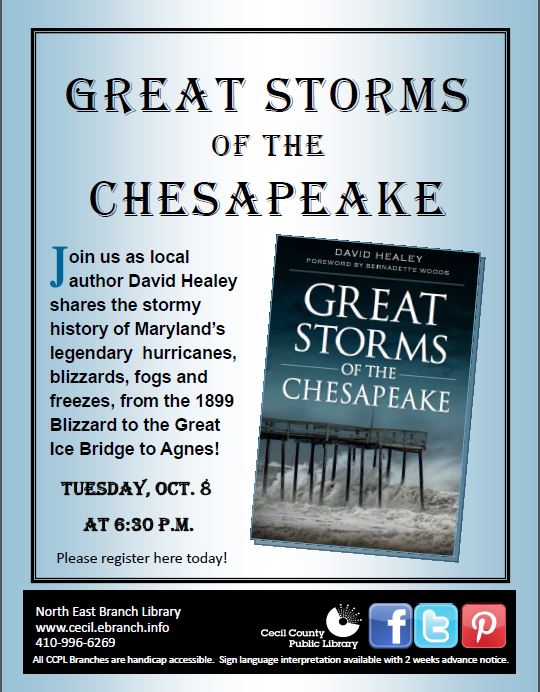
GREAT STORMS OF THE CHESAPEAKE talk this Tuesday at North East Library!

Great storms Nor jpg

Posted in Great Storms of the Chesapeake | Tagged , | Leave a comment

SUGAR POP MOON author John Florio talks moonshine, movies and Prohibition history

SPM cover 96dpiAuthor John Florio will visit the Chesapeake City Branch Library in Maryland on Saturday, Oct. 19 from 2-3 p.m. to talk about his new novel, SUGAR POP MOON. Set in the speakeasies of Prohibition-era Philadelphia and Brooklyn, this is the story of a mixed-race albino named Jersey Leo on the trail of a mobster who sold him some bad moonshine. For the upcoming visit, the author answered a few questions about his book.

 Also, it’s worth noting that John and I both graduated from the Stonecoast MFA program in popular fiction, so needless to say I’m a big fan of whatever he writes!


Why did you choose to make your main character, Jersey Leo, an albino?

The Jersey Leo stories are really about all biases, not just albinism. Had Jersey been a different minority or scarred in some other way, the basic conflicts could have been the same. But there’s a strong, unaddressed bias against those with albinism and it seemed to me that this would be an interesting way to address it.


What interested you about the Prohibition era?

I’ve always been interested in 20th-century American culture, and find those years particularly interesting—not just the bootlegging, but the fashion, the music, the celebrities. Plus, I grew up on Humphrey Bogart movies and hardboiled detective stories, so I felt at home with the material. I often tell people that I wrote SUGAR POP MOON in black-and-white—that is, I pictured many scenes in black-and-white as I was writing them.


What are some of your favorite books and movies set during the time period?

I really enjoyed Dennis Lehane’s LIVE BY NIGHT; and I just began Kevin Baker’s BIG CROWD, which is excellent. Movies include the Bogart canon, along with Cagney, Garfield, and Howard Hawks (director). Off the top of my head, I’ll throw out THE POSTMAN ALWAYS RINGS TWICE, ANGELS WITH DIRTY FACES, and PUBLIC ENEMY.


John Florio headshot 2013There’s a lot of boxing history and lore in SUGAR POP MOON. Tell us a little about that.

I’m fascinated by 20th-century American pop culture, and boxing’s heavyweight champions were a large part of it. I just released a non-fiction book, ONE PUNCH FROM THE PROMISED LAND, about Leon and Michael Spinks, heavyweight champs back in the ’70s and ’80s. You could put that book on the same shelf as SUGAR POP MOON. Not because both include boxing, but because, to me, boxing and noir go hand in hand. In fact, many 20th-century noir writers have been captivated by the world of boxing—not the sport itself, necessarily, but the stories that surround it. The first name that comes to mind is Budd Schulberg, but there are so many others.


Will this be your first trip to Maryland? Have you ever eaten a crab?

I have friends who live in Baltimore, so I’m not a total stranger to the area. When I got married, the gang took my wife and me to a place that served crabs. I think it may have been called Costa’s, although I’m not sure. What I do remember is a hammer, a pile of shells, Old Bay, and a cold beer. Tremendous.

Posted in News and Events, Writers & Writing | Tagged , , | Leave a comment

From Great Storms to President Kennedy to small-town mystery, upcoming talks and book signings set for the fall and holiday season 2013

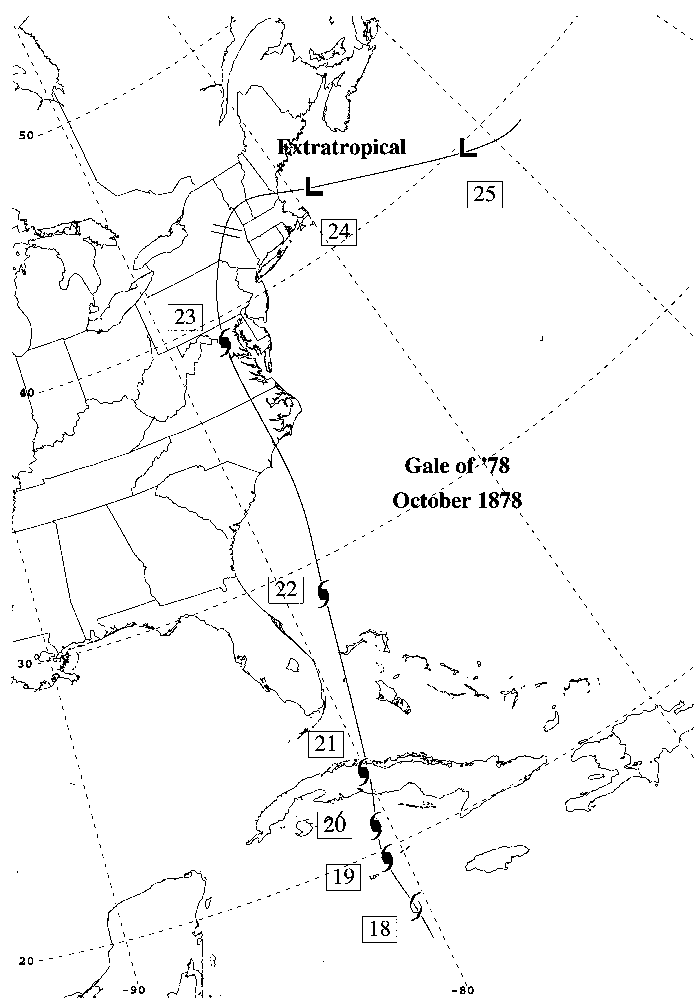
Path of the Great Gale of 1878 that doomed the Chesapeake Bay steamer Express. This was one of the more tragic shipwrecks in Maryland water. Learn all about it at one of the upcoming talks this fall for "Great Storms of the Chesapeake."

Path of the Great Gale of 1878 that doomed the Chesapeake Bay steamer Express. This was one of the more tragic shipwrecks in Maryland water. Learn all about it at one of the upcoming talks this fall for “Great Storms of the Chesapeake.”

So far there are seven events lined up through the fall and holiday season, from talks to book signings. I’m very excited about them all and there’s quite a variety, from a discussion of my new mystery to talks on the Great Storms of the Chesapeake to a discussion of President John F. Kennedy’s visit to the upper Chesapeake Bay region 50 years ago. Hope to see you at an event!

Tuesday, October 8, 6:30 p.m.—Great Storms of the Chesapeake. North East Branch Library, North East, Md. This talk will highlight the legendary hurricanes, blizzards, fogs and freezes around the Chesapeake Bay. Book signing to follow.

Saturday, October 26, 11 a.m.—Great Storms of the Chesapeake. Kent County Public Library, 408 High Street, Chestertown, Md. This talk will highlight the legendary hurricanes, blizzards, fogs and freezes around the Chesapeake Bay. Book signing to follow.

Saturday, November 2, 2 p.m.—Book signing and reading at The Bookplate, 112 South Cross Street in Chestertown, Md., as part of Downrigging Weekend. Washington College Alumnus David Healey will read selections from his new book, GREAT STORMS OF THE CHESAPEAKE. With hurricane season in full swing and our news media covered with stories about the terrific size, scope, and destructive power of these historic storms, Healey will recount the history of several powerful storms that have throttled the Chesapeake, the effects they have had on the Bay, and the outlook for the future. http://sultanaprojects.org/downrigging/lecture.htm

Monday, November 25, 6:30 p.m.—Remembering Kennedy. Chesapeake City Branch Library, 2527 Augustine Herman Highway, Chesapeake City, Md. On the eve of the 50th anniversary of the assassination of President John F. Kennedy, this talk will recount the president’s visit to the upper Chesapeake Bay days before his assassination and invite participants to share their own memories of those emotion-filled days.

Monday, December 2, 1 p.m.—Monthly Book Discussion at the Chesapeake City Branch Library, 2527 Augustine Herman Highway, Chesapeake City, Md. This month’s discussion will feature THE HOUSE THAT WENT DOWN WITH THE SHIP, a mystery novel set in historic Chesapeake City.

Saturday, December 7—Holiday Book Signing at Greenway Farms Christmas Tree Shoppe, Woodbine, Md. www.greenwaytrees.net

Saturday, December 14—Candlelight Tour Book Signing. The Old Gray Mare. Bohemia Avenue, Chesapeake City, Md.

Posted in Uncategorized | Leave a comment

Need a speaker on a writing or historical topic?

speaker picSpeaking Topics

Heroes & Villains of 1812. This talk offers an overview of the War of 1812 in the northern Chesapeake Bay, with a special focus on the personalities of the conflict, including Kitty Knight, Joshua Barney, John O’Neill and Admiral Cockburn.

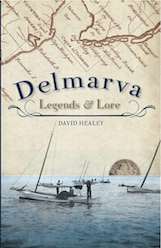
Delmarva Legends & Lore. Did you know about the Marylander who fought a fatal duel with Andrew Jackson? Or how shipwrecked explorers on Assateague Island resorted to cannabilism? This talk offers a look at the sometimes humorous, sometimes tragic history of the Delmarva Peninsula—the land between the bays.

Civil War Legends & Lore. Maryland was a region of divided loyalties during the Civil War era, which gave rise to spies, bitter politics and desperate actions. Learn about the Maryland woman who was Lincoln’s secret cabinet member, the slavecatcher who almost got the war off to an early start, and enduring legends such as the “caveman of the Civil War.”

Great Storms of the Chesapeake. In the last four centuries, the Chesapeake Bay region has experienced legendary hurricanes, gales, blizzards, fogs and freezes. Learn the stories behind this stormy weather and how it forever changed the lives of Marylanders and in some cases, changed the course of history.

First Lines: Getting Started with Your Creative Writing Project. Sometimes you want to start writing a novel, short story or memoir, but don’t know where to begin or what to do with your completed manuscript. This motivational talk and workshop introduces writers to techniques to get them started writing, and offers tips on the publishing process from finding an agent to creating an ebook.


Posted in Uncategorized | Leave a comment

THE HOUSE THAT WENT DOWN WITH THE SHIP gets some press!

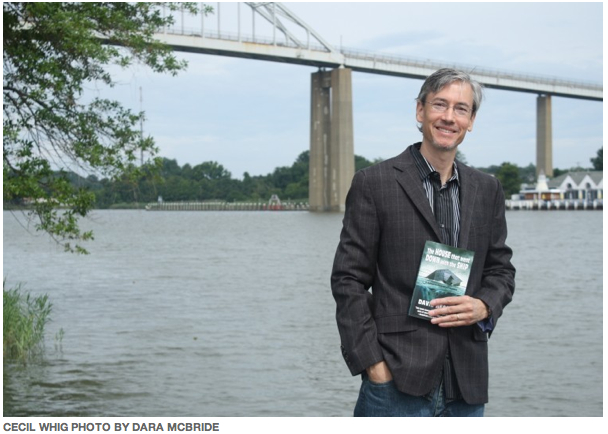
Healey waterfrontHometown history: Author finds inspiration for mystery in own backyard

By Casey Fabris Special to the Whig | Posted: Wednesday, August 21, 2013 7:00 am

CHESAPEAKE CITY — If you live in a house as old as David Healey’s, you never know what you’re going to find in the walls, the floorboards or the attic.

When renovating his 1913 Chesapeake City home, Healey is on the lookout for money.

A few years ago, the son of the former homeowner came knocking. Healey gave him a tour, showing off the various renovation projects he and his wife had taken on in the 20 years since they bought the house.

But the son didn’t seem interested in renovations, Healey said. He had clearly come for something else.

He finally admitted he came to find out if Healey had ever found money hidden in the house. The mystery at Healey’s home ends there. He and his wife still haven’t found any money, but the visit stuck with Healey.

“That little incident got me thinking: What other secrets does a house have?” Healey said.

The encounter gave Healey, an author and former journalist, the idea for his newest novel, “The House That Went Down With the Ship,” which was released earlier this summer.

Healey is the author of numerous published novels and non-fiction works, including historical thrillers and Civil War history. But his latest novel is the first in which he takes the reader to present day and his hometown.

Healey upped the ante for the book – it’s a body that’s found hidden in the walls of the fictional old Captain Cosden home – but the inspiration came from his own experience.

Because the story and the home in the book are loosely based on Healey’s own experience, he decided to set the book in Chesapeake City.

“Of course, I’ve been kidding with everyone that I hope they like the book because it’s set here in town where we live. So we might have to move if they don’t like what they read,” Healey said, laughing.

The history behind Chesapeake City made it the perfect setting for his book, which is a mystery about a home improvement TV show that comes to the town to fix up an old house. When renovations begin, a body is found within the walls of the house, which puts a stop to the project. Tom Martell, the show’s producer, takes it upon himself to solve the murder.

The book draws from Healey’s own “adventures in renovating.” Though he admits he isn’t an expert, it’s definitely one of his hobbies.

“My wife and I have told our kids, ‘Don’t buy an old house.’ On the weekends you may want to do something like go for a bike ride instead of put up drywall,” Healey said.

Setting his latest book in Chesapeake City also gave Healey a chance to spotlight town. The small-town charm is something Healey tried to incorporate into the book, as it’s a trademark of the town.

“Anyone who lives in a small town knows part of what makes it fun is that it’s quirky,” Healey said. “There are quirky people, quirky places in a small town. So as much as possible, I tried to include those in the story.”

Healey insists that none of the characters in the book are based on real people from town and said that was something he made a point to do. Making sure not to include any real townspeople was the biggest hurdle Healey said he had to overcome in writing the book.

Still, he said, there are always some people who think certain characters are a little too familiar.

“The people are original, however, Chesapeake City stars as itself,” he said.

In “The House That Went Down With the Ship,” Healey tried to include tidbits of local history throughout the story. He was careful not to bog it down with too much history, but tried to make it so the reader walks away having learned something.
Though he writes both fiction and non-fiction, history tends to play a part in all of his books.
With fiction, he gets an opportunity to rewrite the past. With non-fiction, he gets to research the real stories of individuals. The processes are so different, Healey said, that he doesn’t prefer one more than the other.

“What’s fascinating about history is that you get to time travel and you really get to use your imagination,” he said. “A lot of people think that history is a lot of kind of dry facts and figures, but, to me, it’s not.”

Posted in In the News | Tagged , , , , | Leave a comment

Chesapeake City stars as itself

HOUSE SHIP poster2We are planning a great book signing this Saturday, August 24 from 10-2 at the Old Gray Mare in Chesapeake City.

While this mystery is just the latest Chesapeake City-centric book, the town has appeared in or helped to inspire more than one book before.

Chesapeake City or “Canal Town” actually has quite a literary history, starting with 19th century journalist and folklorist George Alfred Townsend. A friend and contemporary of Mark Twain, he was sort of the Charles Kuralt of his day. Though nationally famous, he had roots in Cecil County and based many of his stories and books around the Delmarva region.

Later on, Edna Ferber wrote a book called “Show Boat” that became a celebrated Broadway musical. That story was based on the James Adams Floating Theater, whose owners liked Chesapeake City so much that they retired here.

Bestselling author Jack D. Hunter lived in town and his old house is now a bed and breakfast named after his book “The Blue Max” that was made into a movie starring George Peppard, James Mason and Ursula Andress. More recently, poet Erin Murphy lived in town for several years and many of her poems are inspired by the setting.

Local authors such as Kevin Titter, Karen Morgan and Robert Hazel have written some great books about town history.

While no characters are based on actual folks in town, Chesapeake City does star as itself in this mystery novel, starting with Franklin Hall and Pell Gardens. These are real landmarks in town and some of the clues in the mystery come from the historical files found in Franklin Hall. Pell Gardens plays a role. It’s very scenic now, but in the old days it was more of a working waterfront with piles of produce and lumber, along with outbuildings and a watering hole for canal workers.

The characters in the book often refuel at Carl Batzer’s cafe, which is a lot like the Bohemia Cafe at the corner of George Street and Second Street. It’s a gathering spot for locals and visitors, and they have great coffee.

Finally, the Captain Cosden House in the book is actually a Sears house. These houses were mail order kits that you could get shipped to you and then build on your lot. There is at least one rather grand Sears house in town on Bohemia Avenue. Many of the “working class” houses in town were pieced together in the 1850s or earlier out of salvaged materials from old wooden barges or from the lumber mill on the banks of Back Creek.

Hopefully, some of the town history in the mystery can be a jumping off point to learn even more about Chesapeake City’s historical narrative.

Posted in Uncategorized | Tagged , , , , | Leave a comment

REBEL TRAIN becomes a Jeopardy! question

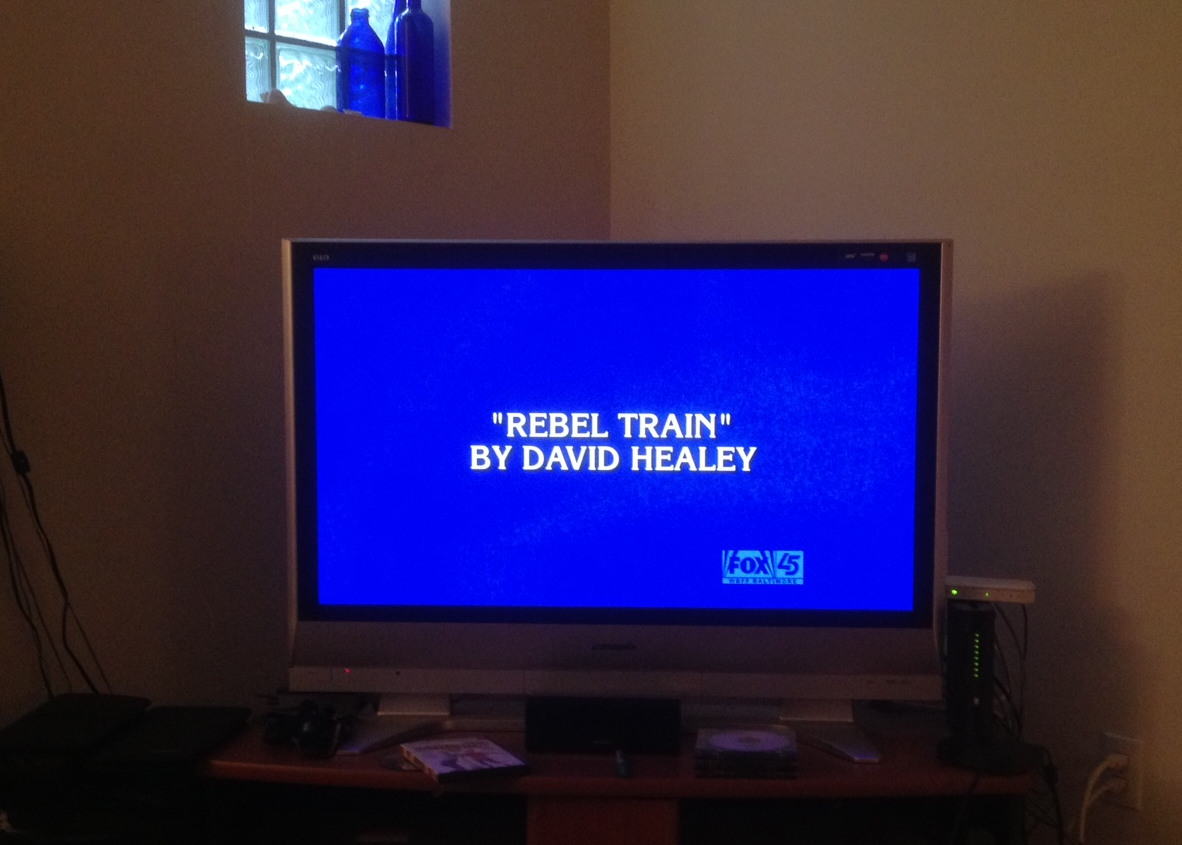
Thank you brother Mike for capturing the "Jeopardy" moment!

Thank you brother Mike for capturing the “Jeopardy” moment!

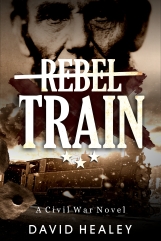
Being mentioned on “Jeopardy” was a lot of fun recently. My novel REBEL TRAIN was in the category War Stories and contestants had to guess which war the novels were about. (Answer in the form of a question: “What was the War Between the States?”)

It remains a mystery to me how my book got right in there with Ernest Hemingway’s A FAREWELL TO ARMS. I wasn’t watching the show … my wife and I were actually driving back from a book signing at Browseabout Books in Rehoboth Beach to promote GREAT STORMS OF THE CHESAPEAKE and THE HOUSE THAT WENT DOWN WITH THE SHIP. Her phone rang a couple of times with excited friends and relatives saying they had just seen the book mentioned on “Jeopardy.” How cool is that!

Salon.com published a piece about the fact that “War Between the States” was accepted as an answer when Alex Trebek was looking for “Civil War.”

I’ve written 10 published books now, and each one of them is a little writing victory, considering that they were all written in the “corners” of what spare time I could find while keeping up with a busy family, working full time, and trying to keep an old house together.  Family comes first, work pays the bills, we need a roof overhead. Where does that leave time for writing? Wherever you can find it, my friend!

REBEL TRAIN was written during a time that would seem particularly unfavorable to writing.

For more than 20 years I worked as a newspaper reporter and editor. For about half that career, my regular shift was from 3 p.m. to 11 p.m. I loved my job and probably wrote hundreds of articles, but what I really wanted to do was write books.

My wife and I had a new baby, a wonderful little girl. Both of us worked, but instead of daycare I took care of our little girl starting around 7 a.m., then dropped her off at mom’s office on my way to work. The only time I had to write my novel was after work at roughly between midnight and one or two a.m. each night—basically until I couldn’t keep my eyes open any longer. Looking back, that was a really grueling time, and it was maybe even nuts to try to write a novel under the circumstances.

What’s even crazier is that I wrote REBEL TRAIN out by hand, in cursive, double spaced, on stacks of legal pads. All 80,000 words of it. There were two reasons for that, one being that this was the late ’90s I didn’t have a laptop computer. I certainly didn’t have my trust Scrivener program yet. The second reason for writing out the novel by hand was that after being on computers all night at work, I’d had enough of that. I welcomed the tactile feel of pen on paper. I sat down in a big chair under a good light, and wrote. Come to think of it, I didn’t even use an outline—not something I would recommend today!

Later on, I typed that stack of legal pads into my Mac desktop computer, revising as I did so.

The story is about a Confederate cavalry officer who is coerced into a secret mission to kidnap Abraham Lincoln on his way to make the Gettysburg Address. The Confederates hijack Lincoln’s train in Maryland and head for Southern territory. What they don’t count on is the determined train conductor giving chase. In fact, this novel is basically about a steam locomotive chase with very high stakes.

I did a lot of research into trains, even getting a lesson in driving an old steam locomotive. Many of the locations in the book are ones I remember as a kid, growing up not far from the B&O Railroad tracks. At night, from our farmhouse you could hear the distant rumble of the coal trains coming down from the mountains, then hear them whistle at the Patapsco River that they followed down to Baltimore.

The book was eventually published by Harbor House Books, and I went with the publisher to BEA in New York to help promote it. Sales have been modest, but when I hold that book in my hands, I know that’s all that counts.

The characters in REBEL TRAIN are determined and driven. Determination can take us far. Writers have to write. It’s what we do. It’s how we stay sane, even if it makes us seem a little crazy at times.

The mention of “Jeopardy” was great fun and renewed some interest in this Civil War novel, so for the next few days I’m offering it free on Amazon’s Kindle store. Get the book and climb aboard REBEL TRAIN.

Posted in Uncategorized | Leave a comment

The case of the missing money, or how my mystery novel began with a mystery

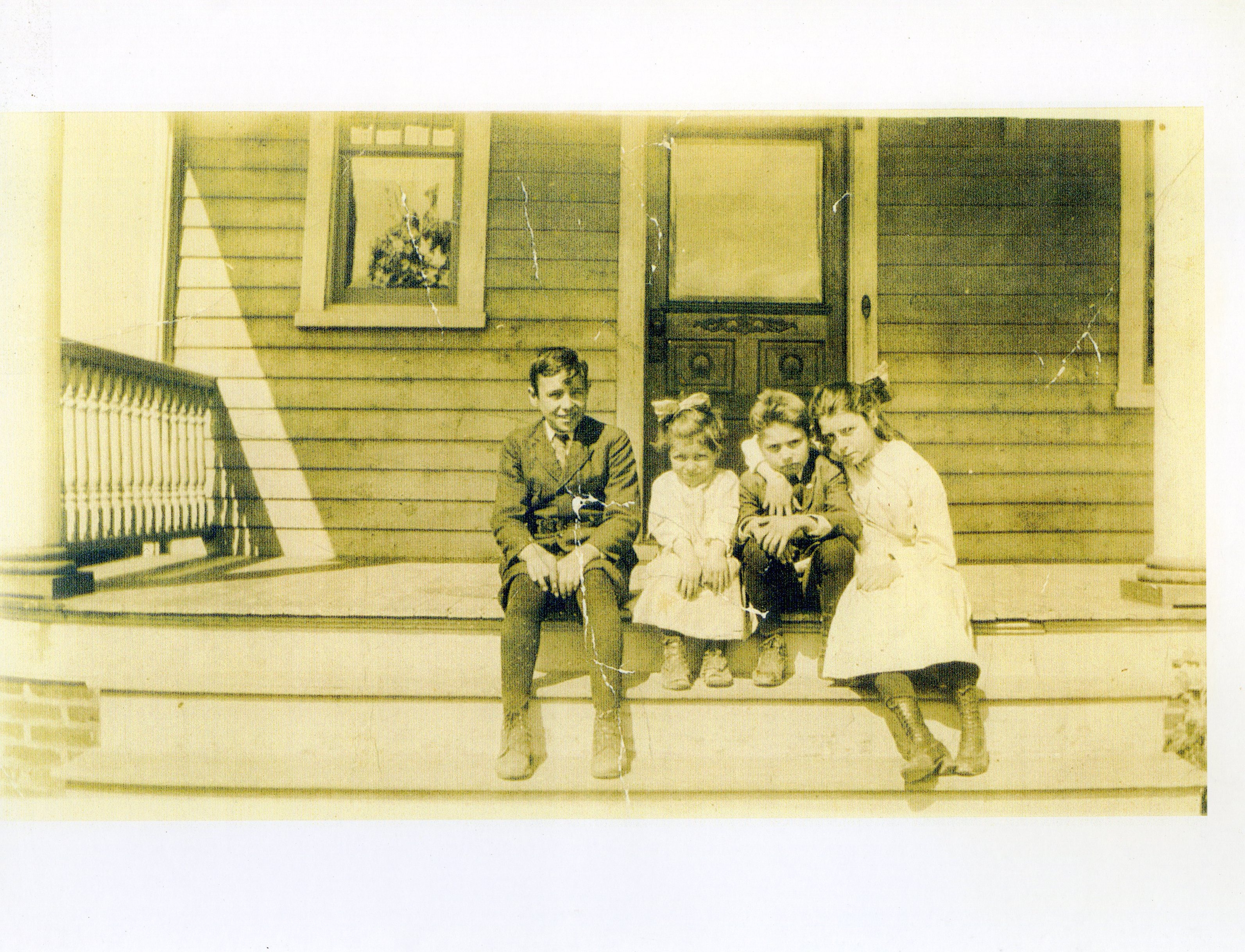
These are the Cooling children on the front porch of our house, probably in the 1920s. The boy second from the right is Walter Cooling, who once stopped in to visit and pointed out that we still had the same clawfoot tub he grew up with! The front door is also the same. Thanks to Robert Hazel for the photograph.

These are the Cooling children on the front porch of our house, probably in the 1920s. The boy second from the right is Walter Cooling, who once stopped in to visit and pointed out that we still had the same clawfoot tub he grew up with! The front door is also the same. Thanks to Robert Hazel for the photograph.

THE HOUSE THAT WENT DOWN WITH THE SHIP began a few years ago with a knock on the front door.

Standing there was the gentleman I’d bought my house from a few years before—actually, it was his mother’s house and he had handled the sale because his mother had been living in a “home” for a few years. (She was 104 at that time.)

I showed him the new ceilings my wife and I had put up, how we had stripped the old wallpaper, and generally updated the 1913 house as much as our budget would allow. But the old man seemed a little antsy. Finally he got to it and asked, “Did you ever find any money in the house?”

“Should I have?”

“Oh, just askin’.”

He never really explained, but I surmised that what it came down to was that his mother didn’t have as much money in the bank as he thought she should. Like a lot of Depression-era people, he probably suspected that she had hidden it in the house or buried her cash in a Mason jar out back. (Question: would the Mason jar method be the opposite of online banking?)

Let me be clear that he was a good guy and he treated me and my lovely future wife fairly back during the sale, but in the end he hadn’t stopped by to talk about the best techniques for steaming off wallpaper. He really thought mom had hidden her stash in the house!

The closest we’ve come to any cool discovery of that sort was when my hardworking wife steamed off wallpaper in an upstairs bedroom and many layers down, found that someone had scrawled the date 1942 on the plaster wall.

But the question about hidden money got me thinking about the secrets that an old house keeps. The walls are witness to a lot of arguments, love making, joys and sorrows over a century. Someone was born in our house. Someone else probably died.

Those are the more ordinary secrets any old house keeps. But what if there was something more sinister that was hiding in (almost) plain sight?

It’s these “what if” moments in which so many stories get their start.

In THE HOUSE THAT WENT DOWN WITH THE SHIP the more sinister aspect is a body hidden in the wall and then discovered by the renovation crew 90-plus years later.

House FBThe first few chapters went through the Popular Fiction Workshop at the Stonecoast MFA program in Maine. It was there that the amazing writer and workshop leader Kelly Link suggested a plot twist. Her advice was to have the narrator Tom sleep with Jenny, the star of their online home improvement show. That to me makes the story and adds just the right tension among the characters beyond the challenge of solving the mystery.

From there, the story evolved and I just knew it had to be set in historic Chesapeake City and that the Captain Cosden House would be loosely based on our own house and our own renovation adventures and misadventures.

So far we haven’t found any bodies—or any money for that matter, though I’m still looking! What I did discover was a story that needed telling.

Posted in Writers & Writing | Tagged , , , | Leave a comment

Mystery cover revealed!

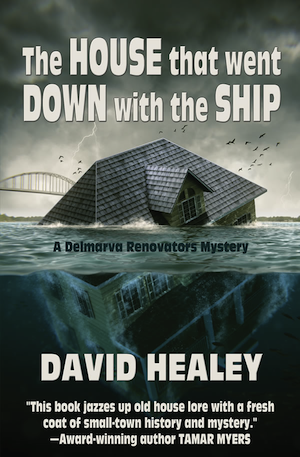
House FBI just wanted to share this wonderful cover for my upcoming mystery THE HOUSE THAT WENT DOWN WITH THE SHIP. The cover went through various versions (we’ll skip the earlier ones here) and thanks to the patience of my editor at Bella Rosa Books and the talented artist Nick Deligaris, we arrived at the final version shown here.

As I written elsewhere on this blog, covers can be tricky. Consider yourself lucky if you are working with a publisher who is willing to adapt (or is that adopt?) your ideas.

If truth must be known, I cast about for ideas on one of those stock photo websites, but nothing quite grabbed me. I had this idea of a house under water (we’ve heard that term a lot these days, haven’t we). However, it was hard to really show that the house was sitting on the bottom of the Chesapeake Bay. Showing the house sinking gives the cover a more active feel. Splash! You can really see that house going down.

A nice touch is the bridge in the background, which represents the Chesapeake City bridge. (This is the real-life waterfront Canal Town where the mystery is set.)

The artist was really helpful in that he quickly changed things around when I didn’t go for the first house he picked. I was able to take some photos of an American Four Square, which is featured in the book, and send them his way.

While the artist created the illustration, it was the publisher who added the text, including the very nice “blurb” from Tamar Myers.

What I’m now anxiously awaiting is the actual book! Any day now, my friends!

Posted in News and Events | 1 Comment