Meet handwriting expert and writer Sheila Lowe

(The following article appears in the January issue of The Big Thrill, published by the International Thriller Writers.)

By David Healey

Be warned. At one glance, author Sheila Lowe can almost instantly know your deepest secrets and take the measure of your personality. For these insights, she does not rely on clairvoyance or palm reading, but on something seemingly more mundane.

Your handwriting.

Lowe is a professional graphologist, or handwriting expert. In fact, she is one of the leading experts in the United States, if not the world, and serves as president of the American Handwriting Analysis Foundation. She has written nonfiction books on the topic, Adobe has employed her knowledge in developing its signature recognition software, and Lowe has weighed in on the handwriting of President Trump in media outlets such as CNN and The Boston Globe. (“It’s like a big fence,” she says of the president’s jagged signature.)

It is an expertise that serves her well not just in the corporate world, but in the world of fiction. Since 2007, her popular “medium-boiled” series featuring handwriting expert Claudia Rose has been engaging audiences. Her newest installment is WRITTEN OFF, in which Claudia finds herself flying from sunny California to wintry Maine in order to retrieve the manuscript of a murdered psychology professor. Claudia’s expertise enables her to gain insights into the characters who are now persons of interest in the professor’s death.

There’s more at stake here than catching the killer. The dead professor has left behind a considerable fortune and a mansion. She also has left behind a ragtag mix of troubled students. Again, handwriting plays a role in seeing beyond the facade that characters may be presenting to the world.

Like her character, Lowe lives in California, writing from a curving desk in her Ventura home that her friends call “the command center.” It occupies half her kitchen and is filled with monitors and stacks of folders and notes. There is even a microscope for Lowe’s other professional pursuit, which is handwriting analysis.
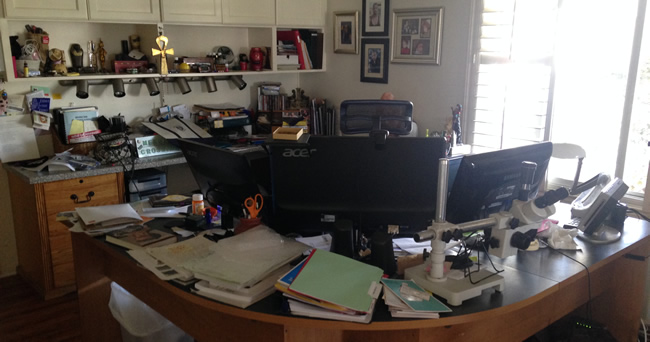
Sheila’s command center

In a phone interview from that desk, Lowe comes across as wise and kind and insightful, much like her character.

Lowe was born in England, but has lived in the U.S. since she was a teenager. Lowe’s bio prominently mentions family. One son, Erik, is a tattoo artist. Another son, Ben, has performed for many years with the band Snap. (Lowe’s adult daughter, Jennifer, was the victim of a domestic homicide in 2000.)

A tattoo artist? A rock star? This is someone who encouraged her children to follow their bliss.

“It makes me the cool mom,” she acknowledged with a laugh. “It’s OK with me. I just want them to be happy.”

She noted that Erik helped with some insights into tattoo art as part of Lowe’s fifth novel in the series, Inkslinger’s Ball. “He took me to a tattoo convention for research,” she said.

And for the record, Mom did not get a tattoo.

An interesting quality of WRITTEN OFF is that while handwriting analysis features prominently, it is not necessarily the tool that brings the killer to justice. Instead, Lowe noted, the handwriting analysis helps to give Claudia insight into the other characters.

I sent Lowe a sample of my handwriting, which she was kind enough to analyze. Her response was intriguing: “I’d guess you write thrillers to give the rather dark side of your personality an outlet.” What I deemed as sloppy handwriting, she described as impatient. Based purely on handwriting, Lowe went on to theorize about a childhood experience that shaped my adult personality. Her insights from a single hand-written page were revelatory, and quite unsettling.

Suddenly, I felt like a character in one of her books. I was reminded of the captivating scene in WRITTEN OFF in which Claudia analyzes the handwriting of skeptical faculty members during a cocktail party. The scene serves to offer insights into characters who might be suspects in the professor’s death. In the process, Claudia reveals traits and histories that leave some characters reeling. It’s anything but breezy party entertainment.

As a graphologist, she spends several productive hours early in the day on her consultant work in the field, before moving on to writing.

CURIOSITY OF THE DAY: Presidential autographs for sale.

As for her writing habits, Lowe said that she is “allergic to mornings” and tends to start writing around 10 p.m. and work until 1 a.m. or so—unless there’s a deadline looming, in which case she gets an earlier start. Her daily goal is to edit the writing from the previous day and then produce around 1,000 words of new material.

“Writing is hard,” she said. “I like rewriting. I like having written.”

She needs to start with a title, which is a quirk of many writers. The next step is to rough out the plot in a notebook so that she knows where the story is going. Once that is done, and the story is formed in her head, she sticks to the keyboard. The writing all gets done at that command center.

“I don’t feel tied to those notes,” she said. “I really don’t look at it again until my book is finished and I just go back to make sure I got in everything that I wanted to.”

If she gets stuck along the way, she finds that employing “grapho-therapy” is useful. The technique uses handwriting exercises done to music to encourage creativity.

What’s next for Claudia and this intriguing handwriting series? Judging by her brush with a Maine blizzard in WRITTEN OFF, Claudia may be taking some time off to warm up while Lowe writes an altogether different novel.

Until then, there are six previous novels in the series to catch up on, and a lot of handwriting clues and insights to consider.

*****

The mother of a tattoo artist and a former rock star, Sheila figures she’s a cool mom. She lives in Ventura with Lexie the Evil Cat, where she writes the award-winning Forensic Handwriting series. Like her fictional character Claudia Rose, she’s a real-life forensic handwriting expert who testifies in court cases. Despite sharing living space with a cat, Sheila’s books are “medium boiled,” psychological suspense, definitely not cozy. She puts ordinary people into extraordinary circumstances and makes them squirm.

Her non-fiction books about handwriting include The Complete Idiot’s Guide to Handwriting AnalysisHandwriting of the Famous & Infamous, and Handwriting Analyzer software.

To learn more about Sheila, please visit her website.

(David Healey is a contributing editor at The Big Thrill.)

Posted in Writers & Writing | Leave a comment

Caveman of the Civil War

Draft dodger lived out the war in hiding

by David Healey

During the Civil War, it wasn’t uncommon to be drafted against one’s will and forced to put on a blue uniform. One Delmarva man hated the Yankees so much that to avoid this fate, he spent several years living in underground hideouts.

The ordeal of John Long, “Caveman of the Civil War,” is certainly one of the stranger tales from the Civil War era on Delmarva. His story was described at length in the Salisbury Wicomico News on May 27, 1920.

It is, unfortunately, a second-hand story, recounted from the childhood memories of the newspaper columnist. The newspaper article, and Long’s experiences, have been summarized by the Edward H. Nabb Research Center for Delmarva History & Culture at Salisbury University.

“Having made up his mind that he would not obey the call of his country to duty, his chief thought was to find some place where he could hide until the ‘unpleasantness,’ as he termed it, ‘had blown over,’ ” the columnist wrote.

Long’s solution was to build “two or three” underground caves. Like most of  Delmarva, the region around Salisbury is a flat and sandy place where caves do not naturally occur. It’s likely that Long built his shelters in stream banks and also along the edge of a place called “Polk’s Pond.”

These caves were more than crude shelters. Long made them big enough to stand up in, with sides and ceilings finished with boards. He built bunks for sleeping but probably had no stove or hearth that might give away his hiding place. The entrance was more than likely disguised somehow to avoid discovery.

Long was able to keep a sharp eye out thanks to “portholes” he built to give himself ventilation and as a means to keep watch. The columnist wrote “Hundreds of times, he said, the (Yankee) soldiers were within a few feet of his hiding place, but by good luck he escaped.”

It seems that the Caveman wasn’t just a draft dodger and Southern sympathizer, but had somehow gotten himself into trouble with the local Federal authorities. A reward was offered for his arrest, and troops combed the countryside looking for him.

Friends apparently kept Long supplied with food, bringing him supplies under cover of darkness. The Caveman, however, wasn’t content to spend all his time hiding out. On several occasions, he donned a disguise— sometimes dressing as a “Negro woman”— and ventured into town. Long was described as being a big man who weighed 240 pounds, so the sight of him in a dress must have been interesting, to say the least.

One of his favorite haunts was a saloon run by “Old Man Hawkins” that once stood on East Camden Street. As the columnist described it, “Here the friends of the north and of the south often met and many a wordy conflict finally terminated in a ‘knock down and drag out’ fight.”

It’s a good bet that John Barleycorn played a role when the Caveman got himself into more trouble than he bargained for one night at the saloon. He got in a fight with several Yankee soldiers. He knocked a few of them down, then punched an officer so hard that he knocked the man out cold. “After a great deal of work on the soldier he was finally revived averring that he had been struck many a time but never so hard as that Negro woman struck him.”  Somehow, the Caveman must have made it safely back to his hideout.

CURIOSITY OF THE DAY: Work healthier with a standing desk.

Was there really a John Long and did this actually happen to him?   When one takes a harder look at his story, parts of it appear to be nothing more than a tall tale, perhaps embellished by the columnist or by the Caveman himself. After all, it seems to stretch the imagination that a young white man, powerfully built at that, could get away with disguising himself as an African-American woman … one who hung out in saloons, no less. And would the Caveman really have stuck around to hear the Yankee officer compliment him on that knockout punch?   If he felt so strongly about the South, he could have slipped into Virginia to join the Confederacy, like so many other young men from Delmarva. But perhaps John Long was a gentle man and something of a loner, happy to mix things up in a relatively harmless barroom brawl but not eager to join the killing fields of the war.

Census records do show a John Long in the Salisbury area. There’s no mention of him living in a cave, of course, but by then the “unpleasantness” of the 1860s was long since over and the Caveman of the Civil War had become a local legend.

(The chapter above is adapted from Delmarva Legends & Lore.)

Posted in Delmarva History | Tagged | Leave a comment

Book 3 in Robert Bidinotto’s Hunter series arrives

Robert Bidinotto is an accomplished thriller writer from Maryland’s Eastern Shore, but it’s his own story of success with independent publishing that many writers find thrilling.

The author has shared his success story at the Bay to Ocean Writers’ Conference held each year at Chesapeake College, and his will return again in March 2018. Here is some of the author’s story.

Having lost his job as a magazine editor, and entering his sixties, his employment prospects looked bleak. That’s when, with the encouragement of his wife, he finally wrote a novel. The result was Hunter, a self-published Amazon super bestseller. The author has been a tireless supporter of other writers with his “how to” advice on his popular website http://www.bidinotto.com/.

For self-published writers, Bidinotto stressed the importance of writing the best books possible by using advance readers, volunteer editors to stop every typo in its tracks, and great cover design.

Bidinotto offers tips for thriller writers and readers, starting with classic examples of great thrillers, including Peter Benchley’s Jaws and Where Eagles Dare by Alistair MacLean and Wilbur Smith’s Hungry as the Sea.  He also noted the thriller elements of classic films like High Noon.

As Bidinotto points out, thrillers come in all shapes and settings, but they have a common thread of often larger-than-life characters who overcome impossible odds, whether it is stopping a killer shark or the gang of killers due to arrive in town on the 12 o’clock train.
“Your job is to keep the reader riveted in that world,” Bidinotto notes. He quotes Lee Child: “Write the slow stuff fast and the fast stuff slow.”

Bidinotto has written a sequel to his bestselling Hunter, which also has become an Amazon bestseller. Just this month, a third book in the series was released, called Winner Takes All. The story focuses on an attempt to install a puppet president in the White House. Sounds like yet another great Robert Bidinotto thriller!

Posted in Writers & Writing | Tagged , , | Leave a comment

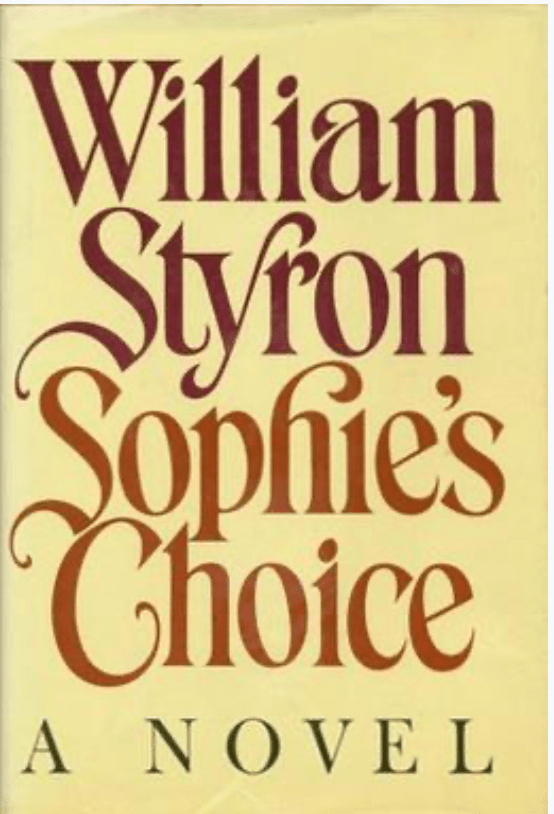
Writer’s Choice: William Styron, white wine and the power of imagination

Tall, white-haired, and with a Virginia gentleman’s accent, William Styron looked and sounded like a Southern writer. But what really impressed me was that we had the same taste in alcoholic beverages.

This was in 1986. I was nineteen and the Pulitzer Prize-winning author was visiting Washington College in Chestertown, Md., to instruct and inspire the young writers there, which is why I found myself at the door of the President’s House to have dinner with Styron, faculty and students. The president at the time was Douglas Cater, himself an accomplished journalist and Southerner.

A solemn-faced waiter wearing white jacket greeted me just inside the door of the 18th century mansion.

“May I get you a cocktail?” he asked.

Under the circumstances, it felt more like a pop quiz than a question. It didn’t seem likely that the bar at the president’s house was stocked with Natty Boh.

“Ahh . . . I’ll have a glass of white wine,” I said.

I heard a deep voice behind me. The great man himself was coming in the door. “That sounds like a fine idea,” Styron told the waiter. “I’ll have the same.”

At that point I stammered something witty like, “Hello, Mr. Styron,” and retreated – glass of wine in hand – into the crowded house. I hadn’t read any of his books yet and feared that he might ask me how I liked them. The college had invited prospective freshmen to the event, and they were there with their parents, getting a feel for the place. Several parents looked uncomfortable in that genteel Tidewater setting, or maybe it was only the thought of the tuition that was making them sweat.

“What wonderful knickknacks,” one nervous mother remarked to Libby Cater, wife of  President Cater and lady of the house.

Libby, ever so polite, replied, “Oh, do you like my jade collection?”

Knickknacks, indeed.

As the newly educated mother and daughter moved on, Libby turned to me and confided how pleased she was that Styron, a one-time neighbor of the Caters, was visiting the college. The college was small enough then that even the first lady had a passing acquaintance with a college freshman she had seen around the Lit House on campus. Then her voice dropped a note as she added, “You know, one day he was out getting his mail when I was in the yard and he showed me a royalty check for forty thousand dollars.” Libby appreciated good writing, but she also knew the value of all things green.

Over dinner, Styron shared how the idea for “Sophie’s Choice” was born in a flash of inspiration that soon had him on a research trip to a concentration camp. Published in 1979, “Sophie’s Choice” became a bestseller and was made into a film starring Meryl Streep as the pale Holocaust survivor. Styron graciously answered the students’ questions on writing. He was self-effacing, even subdued, which makes sense now: this was soon after he nearly committed suicide, as revealed in his memoir “Darkness Visible: A Memoir of Madness.” One thing became clear, which was that Styron was a thoughtful man who loved storytelling and the craft of writing.

He read that evening from a work in progress about his days as a Marine during World War II, tough material for a college-age audience forty years removed from their grandfathers’ war. However, that didn’t stop me from reading “Lie Down in Darkness,” an experimental 1951 novel with echoes of Faulkner that nonetheless seemed as relevant to the ’80s as two other hot novels of self-destruction I devoured about the same time, “Less Than Zero” and “Bright Lights, Big City.”

Late at night, I would plow through all sorts of books that had nothing to do with class assignments. On a Styron kick now, and hoping I might be able to pair his advice to something I found in his writing, I plowed through “Sophie’s Choice.” The true horror of Sophie’s situation wouldn’t sink in until I dipped into the novel again after having children of my own. Now, from a parent’s perspective, Sophie’s guilt and grief seems overwhelming. The novel’s language is lush as a steamy Southern night.  This is writing that takes its time covering more than 600 pages.

The book I never got around to was “The Confessions of Nat Turner,” about a bloody slave revolt in 1831. Since I seem to have made a habit of catching up on Styron after the man has come and gone, I’ll have to read that one next.

I’ll never write as well as Styron, but I understand from him that it is the writer’s imagination that matters most of all. You don’t have to be a Polish Jew or an African-American slave to understand your characters. A good writer must be able to imagine his way into his characters’ souls.

“A great book should leave you with many experiences, and slightly exhausted,” Styron once said. “You should live several lives while reading it.”

I won’t say that Styron inspired me to be a writer, but he certainly taught me that it was OK to be one. . . and that a glass of white wine was a perfectly acceptable cocktail.

(I wrote this essay when the author passed away in 2006, and it was distributed nationwide by by Scripps Howard News Service. Lately, I’ve been thinking of those late nights spent reading his books and how rare it now is to find anything so deeply written.) 


Posted in Writers & Writing | Tagged , , | Leave a comment

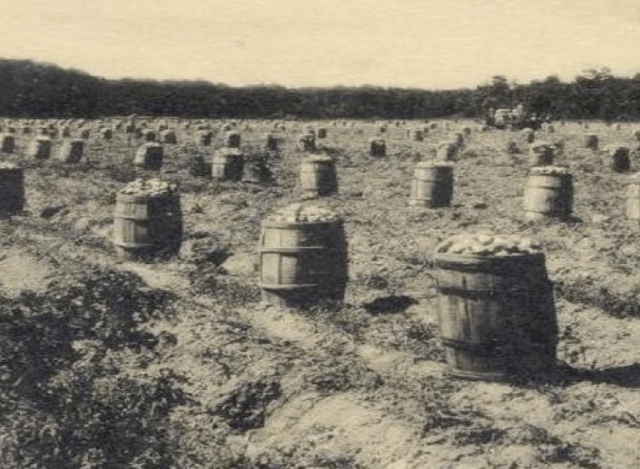
Eastern Shore White Potato Pie recipe

Eastern Shore potato harvest. Photo courtesy the Cecil Observer.

This is a season for comfort foods and family recipes. In keeping with that spirit, here is a recipe for White Potato Pie, which is a uniquely Eastern Shore dish.

Our family first got a taste of this thanks to our wonderful neighbors and good friends, the late Dot and Sterling Hersch. It was around Thanksgiving one year that Sterling brought over (most) of a White Potato Pie. There was a slice or two missing — no wonder!

Dot and Sterling were longtime Chesapeake City residents and raised their family here. Sterling grew up in the town of Rock Hall, in Kent County, back in the “good ol’ days” of the early 1900s. His father ran the general store there. Dot grew up around Galena. These pies were a popular treat back then, when more exotic ingredients and baking supplies (brownie mix, canned pumpkin, etc.) probably weren’t available or too expensive. There were, however, plenty of potatoes.

It’s much harder to find White Potato Pie these days than it probably was back then. Pumpkin pie has largely taken its place. I did find white potato pie for sale at the Chesapeake Folk Festival in St. Michaels, Md. And you can be sure that I helped myself to a piece. Maybe even two.

Dee (Hersch) Thomas wrote down this family recipe and shared it with us. I don’t think she will mind it being posted here. If you want to taste a real Eastern Shore tradition, look no further. And perhaps you will start a family tradition as well.

Hersch’s White Potato Pie

4 cups mashed potatoes

1 1/2 cups sugar

1 stick margarine or butter

4 eggs separated

1 large can Pet evaporated milk

1 tsp. Vanilla flavoring

Mix potatoes, sugar, butter or margarine, egg yolks, evaporated milk and vanilla in large bowl.

In another bowl, beat egg whites until stiff and fold into the above mix. Pour into unbaked pie crust and bake at 325 degrees until set. About 45 minutes.

Makes 3 pies.


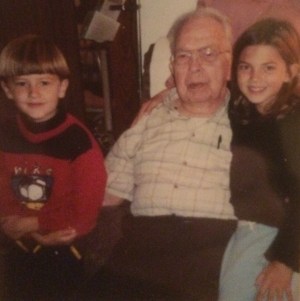
Sterling Hersch with Mary and Aidan.

Posted in Delmarva History | Tagged , | Leave a comment

Mmm. Mmm. Muskrat. Coming to a plate near you.

COURTESY OF MARYLAND DNR.

On the Eastern Shore and Delmarva Peninsula, people are known for eating all sorts of things that raise eyebrows elsewhere.

Crabs, for starters.

Up in New England, they look at you kind of funny if you walk into a seafood restaurant and ask if they have steamed crabs.

“No, but we have lobster,” the waitress will say, doing that funny thing with her r’s.

That’s a Yankee for you. Any fool knows crabs with lots of Old Bay seasoning are much better than a boring old boiled lobster.

People on the Eastern Shore and Delmarva Peninsula also eat soft—shelled crabs. They taste great, if you can ignore the legs poking out the sides of the roll (although some say that a true soft-shelled crab sandwich is served only on white bread).

Other regional specialities include oysters, Maryland beaten biscuits, and Smith Island cake.

The one dish that you’re not as likely to see on any tourism brochures, however, is muskrat.

These furry critters live in both fresh— and saltwater marshes on Maryland’s Eastern Shore and in Delaware. Also known as “marsh rabbit,” they are considered a Delmarva delicacy whether stewed, fricasseed or fried.

The meat is a byproduct of trapping, because what the muskrat is really known for is fur, not food. There isn’t as much demand for the fur these days because of the politics of fur. But at one time, a muskrat coat was warm and stylish.

CURIOSITY OF THE DAY: Faux fur

You do not have to be a muskrat trapper to make this dish, although you may have to be just as rugged.

A skinned muskrat in a display case at a country market looks like … well, let’s just say that it does not resemble a New York strip steak.

A muskrat also costs much less than grass-fed Angus. I have seen muskrat for about $1.50  each.

Generally, you have to put in an order for muskrat at these country markets.

If you don’t want to cook it yourself, then you can sample muskrat at various places. A few diners have it on the menu in season. Then there’s the Methodist church in Hancock’s Bridge, N.J., where they’ve been holding annual muskrat dinners for over 50 years. They reportedly cook up 1,800 of the critters, or about one ton of muskrat meat.

For anyone who wants to feel like a real Eastern Shoreman and cook his own muskrat, here’s a recipe from “The Joy of Cooking” by Irma S. Rombauer and Marion Rombauer Becker.


Muskrat 

Skin and remove all fat from hams and shoulders of l muskrat. Remove musk glands under legs and belly and white stringy tissue attached to musk glands.
Poach in salted water for 45 minutes.

Drain.

Place cut-up meat in a dutch oven and cover with bacon strips. Add:

1 cup water or light stock 1 small sliced onion

1 bay leaf 3 cloves

1/2 teaspoon thyme

Cover and simmer until very tender. Serve with creamed celery.


With all due respect to “The Joy of Cooking,” I would prefer mashed potatoes with my mukrat. However, I suspect that the muskrat itself will overshadow most side dishes.

Just wait until your guests or family members are saying, “Boy, this is delicious. What is it?” Then tell them they’re eating muskrat. They won’t notice if that’s creamed celery on the side or old boiled socks.

Mmm, mmm, muskrat. Enjoy.

Posted in Delmarva History | Tagged , | Leave a comment

A WWII detective solves murders on the homefront

By David Healey

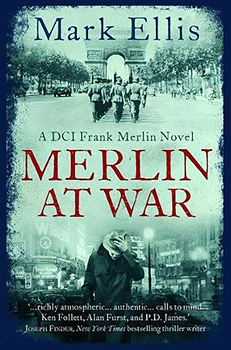
Writing in a comfortable studio surrounded by books, the scenes playing in the mind of Mark Ellis are not nearly as peaceful: German dive bombers machine gunning troops on the run, war-torn London, a woman’s bloody body in a hotel room.

The British author’s latest effort is MERLIN AT WAR, in which much of the plot centers around a mysterious letter left behind by an officer killed by those dive bombers. Interestingly enough, the main character is not a soldier, but Chief Inspector Frank Merlin. While war rages, there is no shortage of home front crimes for Merlin to solve.

“People carried on,” Ellis said. “Life carried on.”

And so did crime.

According to Ellis, the wartime blackouts created opportunity for criminals. Looting was commonplace in bombed areas. Rationing gave rise to an underworld of black market goods. He noted that 4,300 cases of looting were tried in just four months of 1940.

It is a side of wartime England that doesn’t quite fit with the “Keep calm and carry on” slogans.

“Police were stretched thin by crimes caused by the bombings,” he noted. He added that the ranks of law enforcement had been thinned when large numbers of police officers joined the military.

“I thought this wartime situation was just a great setting for a crime novel,” Ellis explained.

Mark Ellis signing MERLIN AT WAR in London

After the sale of his computer company, Ellis found himself with time to write. His initial attempt at developing a crime-solving character proved to be a false start. After a few months of work and a lot of pages, he just didn’t find his original version of the character to be to his liking. It took some ruminating during a trip to Spain to find out who Merlin really was, and to give him some Spanish roots, and thus DCI Merlin was born.

For readers of crime fiction, Merlin is a familiar sort of sleuth, but also original and quirky in his own right. Too old to be in the fight, he nonetheless finds plenty of use for his talents as a detective in wartime London. Merlin is surrounded by an interesting cast of supporting characters, including his Polish girlfriend.

The wartime setting also enriches the story on many different levels.

Ellis explained that his interest in the World War II era comes in large part from his own family’s experiences. His father served in the Navy, where he contracted a chronic illness that resulted in his passing away when Ellis was just seven years old. His mother often shared stories of her own war years, from witnessing the bombing of Swansea near her home, to dance parties in London. Even as the war and the London Blitz raged, life went on.

Like many other writers who set their novels in the World War II era, Ellis has tapped a vein of nostalgia for the excitement of the war years that has cast a long shadow even decades later. It’s as if readers are re-living the memories of their parents and grandparents.

“As things recede in time, people seem to get more interested in what happened then,” he observed.

Beyond his own family’s stories, Ellis’s research involved interviews, exploring locales in the novels, and endless hours of reading.

“I have a lot of books,” he noted, gesturing at shelves that run the length of his studio from wall to wall and from floor to ceiling. Mixed among the reference titles are the novels of Graham Greene and Elizabeth Bowen, two writers for whom World War II was a current event. Ellis said he finds inspiration and insights in those pages.

His research with an eye for unusual history paid off.

“A lot of my readers respond very positively to the details. They love learning about the odd, quirky things that they didn’t know about,” he said.

The writing itself takes time and a process that in the case of the most recent novel involved 23 redrafts. Ellis said that he typically writes 1,500 to 2,000 words each day. “I will not leave the desk if I haven’t written that bare minimum,” he said.

Most of the work takes place in that book-lined studio. “Sometimes I like to go to the library for a change of scene,” he said.

What’s next for Ellis? He’s planning a trip to New York to promote the American release of his new novel.

When asked about his plots, Ellis explained that he is not a meticulous planner. After he gets the book going with maybe half of the book planned out, he said he then tends to let the plot lines sort themselves out. One imagines these plot points like the loose ends of a frayed rope that need to be intertwined.

What’s next for DCI Merlin? Considering that MERLIN AT WAR is set in 1940, it’s likely that there are going to be several more years of war, murder, and mayhem in his future, which should leave Ellis fans feeling pleased.

*****

Mark Ellis is a thriller writer and a former barrister and entrepreneur. He grew up in Swansea, under the shadow of his parents’ experience of the second world war. His father served in the wartime navy and his mother witnessed the bombardment of Swansea in 1941. Mark has always been fascinated by World War II and, in particular, the Home Front and the criminal activity which sprung up during wartime. He has written two previous DCI Frank Merlin novels, Princes Gate and Stalin’s Gold and is a member of the Crime Writers’ Association. He divides his time between homes in London and Oxford.

Visit him on his website, or on Twitter at @MarkEllis15.

The article above appears in the November issue of The Big Thrill.

Posted in Writers & Writing | Tagged , , | Leave a comment

3 questions with Delaware Rev War expert Kim Rogers Burdick


Delaware during the Revolutionary War

Award-winning historian Kim Rogers Burdick is the author of the recent book, REVOLUTIONARY DELAWARE: Independence in the First State. She will be talking about the War of Independence in our region during a special presentation at the Elkton Central Library on Thursday, October 19, at 7 pm.

When not writing, she is the curator of the historic Hale-Byrnes House, located on Christiana-Stanton Road.

She generously agreed to answer a few questions about the Rev War in our region.

What person from Delaware’s Revolutionary era do you find most interesting?

I am more interested in the experiences of the ordinary citizens who were over-run  than I am in the soldiers.  I live in an 18th century house that was home of a known Quaker Pacifist. The house was taken over  by Washington to be a site of a Council of War. You can read more about the house and Burdick’s research at https://allthingsliberty.com/author/kim-burdick/

What do you think is the most interesting historical site in Delaware related to the Revolutionary War?

I have a particular interest in the sites along the W3R, which is the route the soldiers followed both in the Philadelphia Campaign and the Yorktown Campaign.  It cuts across New Castle County to Head of Elk.

What lesson do you think those who lived through the War of Independence would share with us today?

There are a lot of parallels between then and now. Life is still (as John Adams later said about the French Revolution) a third; a third; and a third of the people with strong feelings about politics.

Posted in Delmarva History | Tagged , | Leave a comment

Best World War II novels

What’s in your haversack? A few of the best World War II novels

One of the problems with creating a list of best World War II novels is that it can vary according to what we’re in the mood to read. Sometimes we feel like steak, and sometimes we feel like shrimp. Sometimes we feel like an action novel, and sometimes we feel all into espionage. I can also think of a few authors whom I wished wrote WWII stories: Bernard Cornwell for starters, and maybe even John Sandford. Here are a few favorites that never disappoint when in the mood for a good WWII story that you can sink your teeth into.

EYE OF THE NEEDLE by Ken Follett

*Spoiler alert. This novel features a German agent who just so happens to be a diabolical and ruthless killer, pursued by an interesting British sleuth, and ultimately brought to ground by the wife of a sheep farmer. Although this novel is set in WWII, the espionage factor here is really secondary to the fact that this is a ripping good pyschological thriller. I keep a battered copy on my desk and dip into it from time to time when I need a good shudder.

THE EAGLE HAS LANDED by Jack Higgins

This is a novel that I read way back in high school, and wrote a book report for in Mrs. Hawk’s English class. A WWII action thriller not apparently not the sort of novel she had in mind for a book report, and I think I got a B-, but the novel itself deserves an A. The plot centers around a crack team of German commandos who parachute into England to assassinate Winston Churchill. * Spoiler alert. Of course, we readers know from the outset that Churchill was not assassinated. What makes this book so intriguing is that because it is written from the perspective of the German commandos and IRA operative Liam Devlin, it’s not the German soldiers who are the bad guys, but the English.

WAR OF THE RATS by David L. Robbins

Hands down one of the best sniper tales ever written, with one of the bleakest settings, this novel tells the story of real-life Russian sniper Vasily Zaitsev at the battle of Stalingrad. Like Dunkirk or Kursk, Stalingrad was a battle that did not involve Americans, so on the whole we don’t know much about it. Suffice it to say that the title is apt, considering that German and Russian snipers fight a vicious battle through the ruined city on the Volga River. You may be familiar with the similar story told in the film, ENEMY AT THE GATES, but what makes this sniper novel so much better is the POV glimpse into the minds of these urban hunters. Zaitsev’s nemesis is a German sniper sent to eliminate him, resulting in a tense game of cat and mouse between the two marksmen while a much larger battles rages around them.

THE UNLIKELY SPY by Daniel Silva

This best-selling author is best-known for his series featuring Israeli assassin Gabriel Allon, but my introduction to Silva was this early WWII espionage novel. The title seems better suited to a cozy mystery than to a high stakes thriller wrapped around the war of deception surrounding the D-Day invasion, but this story twists and turns like a rat’s maze to the point that you don’t know who to trust. The main character is an “everyman” college professor thrust into the high stakes game of winning the war.

SNIPER’S HONOR by Stephen Hunter

This novel has one of my favorite chapter openings, “He was an old man in a dry month.” But not too old or too dry, as it turns out. Set with alternating viewpoints in the WWII past and the present day, this thriller features the well-known sniper Bob Lee Swagger, this time on the trail of a little-known WWII female Russian sniper. Not everyone is happy about Swagger’s pursuit of the past and these malevolent forces try to stop him, violently. Anyone familiar with Swagger knows how that turns out for the bad guys. For me as a reader, what makes this novel fascinating is the storyline about the female Russian sniper sent to assassinate a nefarious German leader. Tthe German parachutists depicted in the novel, on whom much of the WWII story also focuses, are reminiscent of those in THE EAGLE HAS LANDED. Tough and competent, they are basically decent men with no choice but to serve a very bad cause.

Read those best World War II novels? Other suggestions for best World War II novels would include books by Jeff Shaara, Alistair MacLean, Steven Pressfield, William Peter Grasso, Griff Hosker, Mark Ellis, Norman Mailer, William Styron, and Robert Harris.

CURIOSITY OF THE DAY: Bookcases!

Posted in Writers & Writing | Tagged , , , | Leave a comment

Chance meeting sparked Civil War romance

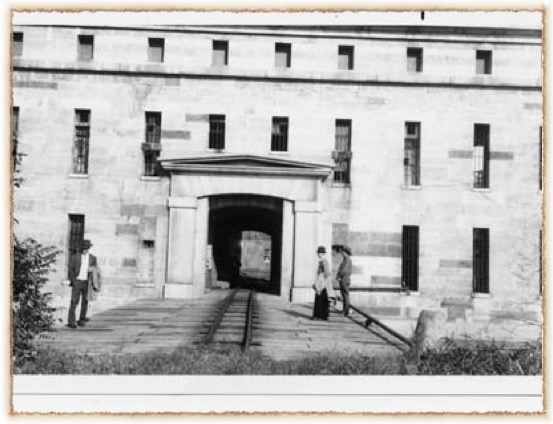
Fort Delaware as it looked in the 19th century. The island fort served as a prison for captured Confederates during the Civil War.

Confederate found love—and a new home—in Canal Town

By David Healey

There couldn’t have been a worse time for Capt. Lucien M. Bean of the 17th Mississippi Infantry.

The Confederacy was crumbling. In the heart of the South, Union Gen. William Tecumseh Sherman was “making Georgia howl.” Confederate Gen. John Bell Hood’s entire army had been smashed to bits by Gen. George Thomas at Nashville. Down around Petersburg, Gen. Robert E. Lee’s troops held on in their trenches, which the Union army would soon overrun.

For Capt. Bean, however, the fighting was already over. He had been taken prisoner near Richmond on Dec. 10, 1864. After a stay at the infamous Old Capitol Prison in Washington, he was sent on Feb. 3, 1865, to Fort Delaware, a Union prison island in the Delaware River.

Bean’s story survives today because he kept a diary of his experiences from 1864 until after the war. He wrote, too, about the lifelong romance that was sparked during his journey to Fort Delaware.

Neither the North nor the South treated prisoners well. Considering Confederate troops had little enough food to begin with, it’s likely the young captain resembled a skeleton as the train filled with prisoners steamed north through Maryland.

Curiosity of the Day: Order an ancestry.com DNA testing kit to explore your genetic roots!

Upon reaching Delaware, the prisoners stopped in the town of New Castle on their way to Delaware City, where the prisoners would be ferried to the prison camp.

One can imagine the scene as the train stopped. Confederate prisoners leaned out the doors of the box cars as the Yankee guards kept watch on the station platform, their bayonets glinting dully in the winter sun. Some of the soldiers probably lay on the floor of the unheated railroad car, too sick or too weak to move, going on to die at Fort Delaware.

Two young ladies happened to be in New Castle that day and caught a glimpse of the Rebels. One was Miss Annie M. Foard of the village of St. Augustine in Cecil County, Md. The other was Miss Julia Jefferson of Middletown, Del.

Capt. Bean spotted the two young ladies and asked their names. Miss Foard passed Bean a card with both their names, along with a scarf to keep him warm at the prison camp.

At Fort Delaware, Bean exchanged letters with Miss Foard all through the winter and spring of 1865. According to his diary, his fellow prisoners kidded him about the scarf.

 * * *

William Stubbs opens Capt. Bean’s diary. The penciled lines are still clear even after 130 years.

“I’d like to eventually write out the whole thing,” says Stubbs, a local historian who lives in a Cecil County farmhouse built in the 1750s by a distant relative. He was given the diary by Carolyn Lorraine of Chesapeake City, a relative by marriage.

The diary is actually inscribed with the name of Sgt. Charles Howard of the 76th New York Infantry. The sergeant from Tompkins County, N.Y., has even written a few diary entries.

How did a Confederate captain end up with the Union soldier’s diary? That’s another story in itself, one that Stubbs gladly shares:

On May 6, 1864, during the battle of the Wilderness, Capt. Bean came across Sgt. Howard, who was lying in the road, badly wounded.

The Wilderness was a terrible fight. Smoke floated in the tangled underbrush. Units were all mixed up.

Bean took pity on the wounded Union sergeant. “I had him moved to the side of the road, to some shade,” Bean wrote. “Gave him water. We then were ordered to advance and I never heard from him afterward.”

In gratitude, the wounded Yankee gave Bean his diary. Bean used it to keep a faithful account of events from that day until after the war. His words help tell a love story that brightens a dark chapter in the nation’s history.

Stubbs closes the diary, wraps it again in protective plastic, then returns it to his bookshelf.

“I consider myself the custodian of the diary,” he says.

* * *

Fort Delaware remains a forlorn and imposing place, and it must have been even worse for a young prisoner. Visitors have claimed to see ghosts walking the narrow brick passageways. Cold wind off the Delaware River still washes between the open iron bars on the windows.

On June 19, 1865, the misery ended when the prisoners were released.

Set free, Bean briefly visited Wilmington, Del., and Philadelphia. He then journeyed to the Foard home, where, according to his diary, ‘The most important events of my life occurred during the week I enjoyed with my friends at St. Augustine, Md.”

From Cecil County, Bean returned to his home in Buena Vista, Miss. But not for long.

That autumn, Bean and Annie Foard were married at St. Augustine Episcopal Church. Julia Jefferson, who had been at the train station the day the future newlyweds met, was the maid of honor.

Bean went into business in nearby Kent County, Md., for a few years, then moved his wife and family to New York, where he worked for the West Shore Railroad.

In later years, he and his family returned to Chesapeake City in Cecil County. He died there in 1921. Annie died in 1924.

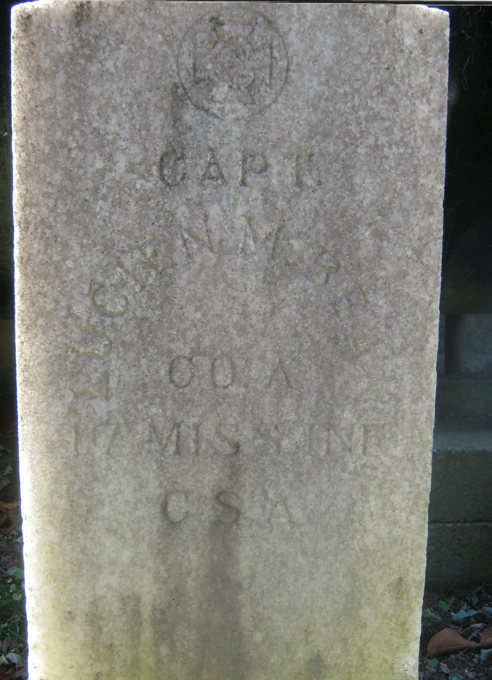
Captain Bean’s headstone at St. Augustine Church in Chesapeake City, Md.

Bean and his wife are buried side by side in the St. Augustine Church cemetery. Annie’s headstone lists her date of birth as 1841. The modest headstones are tucked up tight against the side of the church. Nearby are the graves of three Union veterans.

If it weren’t for Bean’s diary, no one would ever guess his interesting story from the simple inscription on his headstone:

Capt. Lucien M. Bean

Co. A., 17th Miss Inf.

C.S.A.

There are no dates for his birth or death. Bean and his survivors must have been proud of his service to the Confederacy to use it as his only epitaph 56 years after the War Between the States ended.

(Originally published in The Washington Times on Aug. 8, 1999)

Posted in Delmarva History | Tagged , , | Leave a comment