Author Lee Gimenez on Blacksnow Zero

The following article appears in The Big Thrill.

By David Healey

Author Lee Gimenez is one of those rare writers who still uses a pen and paper to craft his stories, often in a coffeeshop or sometimes in the backyard during these pandemic times.

Day by day, word by word, those pages have added up to an impressive collection of books in his acclaimed J. T. Ryan series, as well as standalone novels, including his newest thriller, BLACKSNOW ZERO.

BLACKSNOW ZERO—the title referring to post-nuclear snow—features a high-tech and twisty plot that seems worlds away from the author’s handwritten notebooks.

“It’s probably my most plotted book,” Gimenez says, adding that the details of the story were in part sparked by a trip he and his wife, Judy, took to China. “It’s mostly told through the eyes of a young FBI agent.”

According to Gimenez, BLACKSNOW ZERO unfolds as FBI agent Erica Blake investigates the death of a United States senator and uncovers a drastic, top-secret operation led by rogue American generals. Unless she can stop it, the doomsday event will take place in 30 days. Ominously named Blacksnow, the operation plans to free the United States from the crushing debt owed to the Chinese government.

Agent Blake also learns that China has secretly bought massive amounts of American debt, giving the Chinese control over America’s domestic and foreign policy, and making the US president a puppet of the Chinese government. Agent Blake’s life is threatened when she learns top-level people at the FBI are involved in Blacksnow. Not knowing who to trust, she enlists the help of her lover, CIA agent Steve McCord. As Blake’s investigation deepens, she also realizes Blacksnow could plunge America into conflict. With the deadline looming, the two agents rush to expose the conspiracy before the United States becomes embroiled in a worldwide war.

Lee Gimenez

Even a casual reader of today’s headlines will realize the plot comes uncomfortably close to plausibility, given current events.

To add to the countdown construct, each chapter covers a day leading toward the potential doomsday, starting with Chapter 1 on Day 30. Gimenez says this made the plotting quite intricate because changing one plot point as he wrote could reverberate back through the whole structure of the book.

“I had to do quite a bit of research for this book,” Gimenez says. “One of the elements of the novel has to do with the ever-growing national debt of the United States. Because of this massive debt, the USA has borrowed large amounts of money from other nations, such as China, Japan, and other countries. This has made our country very vulnerable; in effect, our domestic and foreign policy can be influenced and even dictated by foreign countries, which is a dangerous situation.”

Along with the tense plotting and current-events elements, something else that makes the book stand out is that a male author wrote a female main character.

“She’s a tough, take-no-prisoners type of woman who also has a sarcastic side to her,” Gimenez says of Agent Blake. “I use that humor to relieve the tension of the deadly situation she deals with. Blake has an on-and-off relationship with her ex-husband, and in this novel, she seeks his help with the investigation. Their personal relationship creates its own drama and conflict.”

Gimenez really enjoys the dynamic between Blake and her ex-husband. “I like the approach of a woman and a man in the key roles,” he says. “They bounce ideas off each other. One gets in trouble and the other one comes to help.”

On a more personal note, Gimenez credits his wife with being a good sounding board for the credibility of his characters’ actions and dialogue, and she also helps with cover design.

In addition to his own world travels in the military and then as a business executive, Gimenez says several authors have influenced his writing. His list of favorites includes David Baldacci, Brad Thor, Robert B. Parker, Lee Child, and Janet Evanovich. Many of their books fill his home office.

“I love to read fast-paced, page-turning novels, and that’s the type of novel I like to write as well,” he notes. “I enjoy putting my hero and heroines in danger. My goal is to create cliffhangers at the end of every chapter. And most of all, I try to include suspense, tension, and conflict on every page.”

That approach has garnered him more than a little success with 15 published novels to his credit. In 2019, Gimenez was a finalist for the 2019 Author Academy Award, and he is a multi-year nominee for the Georgia Author of the Year Award. He was also a finalist for the prestigious Terry Kay Prize for Fiction.

Before his writing career took off, he worked in business management for several Fortune 500 companies. Prior to that, he served as an officer in the US Army. He is a graduate of Georgia Tech University and also earned an MBA degree.

These days, Gimenez is happy to keep filling up those notebooks in longhand and typing up what he’s written, giving him an opportunity to revise his words.

“I wish I could write and publish three novels a year, but that’s not realistic for me,” he says. “I research my topics and try to make my novels as realistic as possible, and that takes time. To write a good book, the writing process also takes time. Normally, I can write and publish two novels a year.”

His secret to success? It’s as simple as what keeps him coming back to those notebooks and his keyboard.

“You’ve got to love writing.”

Posted in Writers & Writing | Leave a comment

Wild about foxes

I’ve never been able to take a good photo of a fox, so had to rely on this photo by Thomas Butler on Unsplash.

Earlier this week, I was out for my evening walk and I had a good bit of luck because I saw a red fox sitting in the path ahead. We started out some distance apart, keeping a wary eye on one another, but as I got to within about 50 yards away he still hadn’t moved.

I thought, isn’t that interesting? I had just reached a point where I was going to clap my hands or maybe head in the opposite direction when the fox jumped up from his haunches and ran off down the trail. Fleet of foot, he rapidly disappeared into the evening shadows. For me, spotting fox and getting that close to him was really special because foxes are one of my favorite kinds of wildlife.

We are so lucky living here at the top of the Chesapeake Bay to be able to see foxes. I understand that in a lot of places the growing coyote population has driven out red foxes because they basically competing for the same resources. One place where I’m almost always sure to see a fox is at Mount Harmon Plantation, where I like to walk from time to time. It’s way off the road and it’s not unusual to see a fox standing in the middle of the dirt lane like a sentry. Again, I always consider this to be a token of good luck.

Sometimes on winter nights if I’m out driving late and the headlights sweep over a big empty field, I will pick out a fox prowling the countryside. Again, the sight of that resilient fox is reassuring.

When I was a kid on the farm, foxes were usually seen as the enemy. Sometimes they would threaten the chickens. For a long time, there was even a fox who would set up shop on the hill overlooking the farmhouse and tease our large dog, who was tied up in the yard. The fox was thumbing his nose at the dog, which just goes to show that the fox was clever enough to know when the dog was tied up. There are still plenty of foxes around on the farm. The last time I stayed there before this pandemic mess, I woke up early and saw one trotting down the lane on some morning mission. That was better than a cup of coffee to start the day.

I don’t much have to worry about the fox raiding the laptop the way that he raided the henhouse all those years ago. To me, the sight of a fox is a symbol of wildness that always gives me a thrill.

Posted in Writers & Writing | Leave a comment

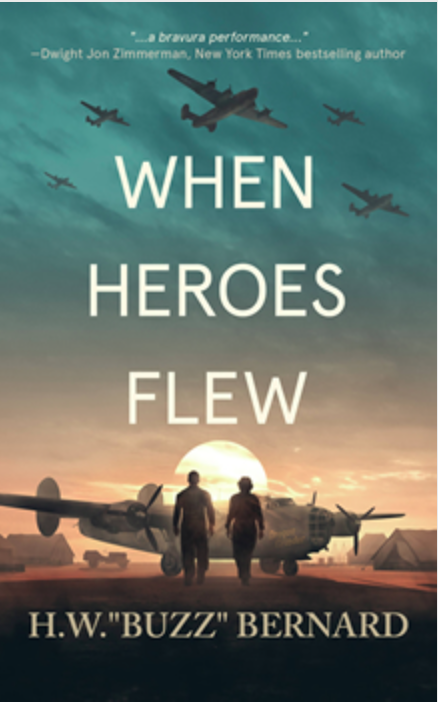
When Heroes Flew by Buzz Bernard

The following article appears in The Big Thrill:

By David Healey

Former Weather Channel senior meteorologist H. W. “Buzz” Bernard is best known for his thrillers related to weather disasters and other natural phenomena. This time around, he has turned his attention to the skies in a new way, writing about a World War II bombing raid in his new historical thriller, WHEN HEROES FLEW.

The novel tells the story of Operation Tidal Wave on August 1, 1943, when more than 100 Allied bombers lifted off from a desert airfield to attack oil refineries in southern Romania, which was then an important oil-producing center for Germany. The raid required a flight of around 1,000 miles while passing over the width of the entire Mediterranean—in itself quite a feat given the technology available almost 80 years ago.

Although the raid was deemed a military success, the cost was great, with nearly half of the planes lost along with their crews, and more than 300 killed on the ground.

In the pages of the novel, Bernard has humanized the story of this remarkable raid.

“I want readers to be in awe of the extraordinary valor and courage exhibited by the Greatest Generation—when they were mere young men and women—in the face of prohibitive odds as they mounted an air attack on Nazi oil facilities in Romania during WWII,” he tells The Big Thrill. “In the particular bombing raid featured in this book, there were five Medals of Honor awarded, the most ever for a single action on a single day. Of the 178 B-24 bombers that launched out of Libya to strike the target, only half made it back in the immediate aftermath of the raid.”

Bernard notes the “absolute bravery and courage” of these young aviators, who knew they probably wouldn’t be coming back. “They knew the odds of survival were virtually nil,” he says. “It’s hard for me to imagine being a young man and being willing to sacrifice your life. It just boggles my mind.”

The novel focuses on a single crew aboard a bomber nicknamed “Oregon Grinder.” The genesis for the novel was a short story that received accolades in an international competition.

H. W. “Buzz” Bernard

“That was the story that the novel grew from,” Bernard notes. “I wanted to try to tell the story from the viewpoint of a single (American) crew and one (German) fighter pilot.”

The focus on the German Luftwaffe pilot helps to give a very human portrait of the opposition. “I can tell you that while the Luftwaffe was dedicated to defeating the enemy, the Allies, many Luftwaffe officers were not Nazis and lived by their own code of honor, not that of the Nazis,” he says.

Part of Bernard’s insight into the Luftwaffe character came from his own time spent in Germany—and from his late wife, Christina, who was born there: “The stories that my wife told me about growing up in Germany during the war gave me something else that I could craft a story around.”

For readers, something else that makes WHEN HEROES FLEW stand out is the attention to detail regarding the planes themselves, and what it was like to fly one.

Bernard gleaned some air combat experiences from friends who flew fighters in Vietnam, where he did two tours of duty as part of his 30-year military career. He eventually retired as an Air Force colonel. Although he describes his role as “support,” he says that being around aviators for so many years has helped to inform his fiction. In fact, some readers mistakenly believe he is a pilot because of the aviation details.

Although Bernard has not been at the controls of a plane, he has flown as a meteorologist on a “Hurricane Hunter” aircraft. For his research into WHEN HEROES FLEW, he did take a trip on a WWII-era B-24 in the skies over South Carolina. He says the experience was not only amazing, but helped him as a writer to get the smells, sounds, and sights just right.

“I do try to get it technically correct,” he says, explaining that he has pilot friends vet those details. “I want it to be real.”

Anyone who has toured a WWII-era plane is immediately struck by the sometimes-rudimentary construction and controls. Today, many passenger jets are essentially flown by a computer, but that wasn’t the case in 1943.

“In those days, everything was very manual,” Bernard notes. There was a compass, for example, but no GPS to give instant positioning. In the raid, the planes skimmed the ground rather than conduct the high-altitude bombing that they were designed for. “A lot of this stuff turned out to be seat of the pants.”

The visit to the past in his fiction is definitely a change of pace for Bernard, and he has decided he might stay there for a while as a writer.

“Once I got into the history, I found it really did interest me a lot,” he says. He has already started writing another WWII novel, this one set in the Pacific.

Like many of us with relatives, friends, or neighbors who lived through WWII, Bernard allows that he sometimes regrets the lost opportunity that their stories could have brought to our writing—if only he had taken the time to hear them. Like hundreds of thousands of young men and women of the Greatest Generation who were in uniform, his own father served in the Navy during WWII.

“I wish I knew I was going to become a writer years ago,” he says. For example, a friend’s father from Germany once surprised Bernard with his flawless English… until he explained that he had been a POW in Texas. Wouldn’t that have been a great perspective to include?

After an accomplished career—actually several different careers as military officer, professional meteorologist, and author—the 79-year-old Georgia resident said he had been considering retiring from writing, but has found that the historical subject matter gives him renewed interest in telling the stories of those who have come before.

“It was something I just felt a calling to do,” he says.

Posted in Writers & Writing | Leave a comment

An interview with Cara Putman, author of Flight Risk

By David Healey

In her ambitious new novel, author Cara Putman takes on so many topics that this thriller is hard to classify. The story touches on human trafficking, the issue of fake news, the consequences of social media, and even alcoholism within families. Where to begin?

“It is hard to put it into a box,” Putman says. “I would call it a legal romantic suspense. It wasn’t a book where I set out to make a statement. It started out more with the theme of ‘Finding truth in a fake news world.’”

In FLIGHT RISK, attorney Savannah Daniels is struggling with her small practice when several worlds collide. First, her ex-husband is accused, along with a famous baseball player, of taking part in sex tourism in Thailand. Next, there is a terrible plane crash in Washington and her former husband was a passenger on that plane. Savannah’s most important legal client becomes embroiled in the crash due to their black box flight recording software. However, her biggest collision may turn out to be with journalist Jett Glover, who wrote the article about her ex-husband. Both Savannah and Jett—who are drawn almost inexplicably together—soon find that the truth may fall between the lines of that article.

“A lot of my book ideas come from headlines,” Putman says, adding that FLIGHT RISK was inspired in part by reading about a baseball player involved in a storyline very similar to the one in the book. “I thought, ‘That is so amazing.’ That kicked everything off.”

But this wouldn’t be a thriller if there wasn’t a twist or two.

Read the complete article in the April issue of The Big Thrill.

Posted in Writers & Writing | Tagged , , | Leave a comment

Knock on bookstores’ virtual doors!

Support our local bookstores through this time

Our local bookstores and shops have been so supportive of me in my 20 years of selling books. My heart goes out to the many small businesses and shops that are doing their part by closing their doors. You can imagine how difficult it is to suddenly stop your income. Shops may be trying to support longtime employees in some way. The rent/mortgage/utility bills are still due. While their physical doors are shut for now, many shops are still selling online. If you need a book or something unique, please knock on their virtual door!

Washington Street Books & Music • Havre de Grace

http://washingtonstreetbooksandmusic.com

Old Gray Mare • Chesapeake City

Lighthouse Gifts • Chesapeake City

https://www.lighthouse-gifts.com

The Bookplate • Chestertown

https://www.thebookplate.net

Kathy’s Corner Shop • North East

https://www.kathyscornershop.com

Browseabout Books • Rehoboth Beach

https://www.browseaboutbooks.com

Posted in Writers & Writing | Leave a comment

Meet The Savage Deeps author, Timothy S. Johnston

Underwater warfare in the next century

DECEMBER 31, 2019 by DAVID HEALEY

By David Healey

Deep under the oceans, more than a century from today, a struggle is being waged for the survival of humanity.

After the devastation wrought by rapid climate change, the remaining world superpowers are coping with how to sustain their populations. Where do people live? How are they fed? Where will resources come from?

This is the future that Canadian author Timothy S. Johnston images in his newest novel, THE SAVAGE DEEPS.

In addition to being a thriller, the novel also poses so many interesting questions about the world in 110 years. Instead of turning to space for survival, Johnston imagines that the answer lies under the oceans. Mineral deposits sit on the ocean floor, waiting to be scooped up. Geothermal heat and oil deposits are there for the taking, along with new fishing grounds. To feed the masses, vast forests of kelp can be grown and harvested.

However, the superpowers are fighting over these resources. It has triggered a new Cold War—and sometimes a hot one.

“The next natural frontier is really the water,” Johnston explained. “Seventy percent of the planet is underwater. The big issue for humanity is that it will likely trigger a new Cold War underwater, and that is the setting of this novel.”

Please click here for the full article.

Posted in Writers & Writing | Tagged , | Leave a comment

On the trail of a stolen Star-Spangled Banner in Deadly Anthem


Read the complete article here

By Tim O’Mara

In David Healey’s new thriller, DEADLY ANTHEM, the Star-Spangled Banner flag is stolen from the Smithsonian, and it’s up to historian Francis Scott Keane (does that name sound familiar?) to get it back. To do so, he will test his knowledge of history and his skills as a researcher as far as he can. He will also discover a disturbing historical twist as old as the flag itself. And ultimately, he’ll have to survive a final showdown in the nightmarish tidal marshes of Chesapeake Bay to determine both his own fate and that of the Star-Spangled Banner.

Healey’s protagonist is a distant ancestor of Francis Scott Key. I wanted to know what it is about the composer of The Star Spangled Banner that he finds so fascinating.

“I always liked Francis Scott Key,” Healey says, “because by all accounts he had a lot of humility and truly believed in the words that he had written, based on being an eyewitness to the flag being raised over the fort. Just imagine seeing that! As noted in the novel, he did not approve of the heavy drinking and bawdy behavior of the Royal Navy officers when he was on their ship.”

And what about Healey’s fascination with the War of 1812?

“The funny thing is, I got into learning about the War of 1812 when I was planting tomatoes in the backyard and found a musket ball. Somebody suggested that it might be from the War of 1812, so I started doing some research and learned that there had been a lot of skirmishes and even a few battles all around the Chesapeake Bay region where I live. In fact, I did so much research that it became a nonfiction book about the efforts to preserve 1812 history in the region.”

There are so many historical figures from that time in American history. I asked Healey if there were any that stood out to him.

“President James Madison is one of my favorites from that era,” he says. “The man was a brilliant intellectual who also happens to be the only sitting president (in American history) to lead troops on the battlefield. It didn’t go all that well, but Madison’s real strength turned out to be holding the government together even when Washington City was burned.”

A good friend of Franklin, Beau, tells our hero, “I like it better when history stays in the past, where it’s supposed to be.” What would Healey say to Beau and others who share similar beliefs?

“The past tends to follow us around, whether we like it or not, like those little bells that people put on their cats. The smart approach is to be aware of that and learn from our mistakes and take some inspiration from our national heroes and ideals.”

We could use more than a little of that these days.

David Healey

I was curious as to how much of DEADLY ANTHEM—particularly the “villain”—is inspired by current events? The White Nationalist movement is a tricky thing to write about without crossing over the cliché line. What makes that interesting to Healey (and the reader)?

“The villain,” he says, “is a bad guy not because of his politics but because he resorts to murder, kidnapping, and theft. He loses his moral compass.”

Healey obviously did plenty of research for DEADLY ANTHEMHow did he know when enough was enough? Did any facts get in the way of the story he wanted to tell?

“Part of the fun of writing a book like this is the research,” Healey says, “but I had to keep in mind that I was telling a story and not writing a history. In a case where truth is stranger than fiction, the British really did capture and burn the United States capital. However, I did tell a bit of a whopper about what the British admiral finds when the White House is captured, but that’s the fun of a ‘what if’ thriller, isn’t it?”

I asked Healey to tell me something about the Chesapeake Bay and that area that might shock ordinary Americans.

“There’s a theory,” he says, “that the Chesapeake Bay was made possible by a giant asteroid strike that threw a tidal wave as far as the Appalachian Mountains. Just a little something to ponder next time we start to take too much for granted—the future can change in a flash.

“We won’t even get into the fact that Marylanders eat raw oysters, muskrat, and soft shell crab sandwiches where the legs poke out from the edges and the eyes stare back at you.”

Good. I’m glad we didn’t get into that.

Finally, I asked if he could put together a panel for ThrillerFest—writers living and/or dead—who would be on the panel and what would the topic be?

“Back in 2015,” Healey says, “I actually was part of a ThrillerFest panel that included Steve Berry, David Morrell, Francine Matthews, Terrence McCauley, Kay Kendall, and others. These are some of the best historical fiction authors working today, so for me the feeling was a bit like when you’re a kid and you get pushed into the deep end of the pool for the first time.

“Our topic was the importance of using fiction to keep history relevant. The only downside was that the panel was just an hour long … I could have discussed history and writing historical fiction all day long with the likes of that group!”

So maybe that wasn’t my final question. That got me thinking. I asked Healey to also talk a bit about readers’ fascination with modern-day experts exposing possibly dangerous secrets from the past. (A la The DaVinci Code and the like.)

“I think most of us,” Healey says, “are pretty sure that there’s ‘more to the story’ when it comes to past events and personalities. That’s why The DaVinci Code or National Treasure-type tales appeal to our imagination. In a sense, history is like a giant Mad Lib that invites fiction authors to fill in the blanks.”

History may not always be stranger than fiction, but in Healey’s DEADLY ANTHEMit sure comes close.

Posted in Writers & Writing | Tagged , | Leave a comment

From the Bay Journal, a history of canvasbacks on Susquehanna Flats

By Ad Crable • Bay Journal (read the complete article here)

(Note: This was a great article about canvasbacks and hunting on the Susquehanna River that I wanted to share here. Reading about those market gunners, it’s amazing that the species survived!)

On a cold morning last February, Bob Schutsky looked out the dining room window of his home along the Susquehanna River in southern Lancaster County, PA, and spied a raft of tightly packed ducks that made his heart race.One male stands out in a raft of canvasbacks on the Choptank River in 2016. (Dave Harp)One male stands out in a raft of canvasbacks on the Choptank River in 2016. (Dave Harp)

Four days before, 36 miles south at the head of the Chesapeake Bay, Rick Bouchelle glanced outside the Upper Bay Museum in North East, MD, and stared in disbelief at a floating flock of ducks.

“They were so thick in there you could walk on them. There were thousands,” the president of the museum recalled, still with a tinge of excitement.

Both men were thrilled to the bone because they recognized the waterfowl immediately as canvasbacks.

For Schutsky, a well-known ornithologist, it was a notable birdwatching sighting. For the next month, he posted daily updates of the canvasback numbers on a statewide website. As the ranks hanging out in the middle of the river swelled to 515, birders came from far and wide to see a species of waterfowl that once dominated the Susquehanna but had been mostly gone for generations.

For Bouchelle, seeing so many of the handsome diving ducks with their distinctive sloping, rusty red heads was like seeing a ghost, and strong memories of the past welled inside him.

Canvasbacks are birds of lore on the Chesapeake Bay. For almost a century, the Bay was the wintering grounds for at least half of all canvasbacks in North America — about 250,000. Hunting for the large and tasty ducks helped define the Bay’s identity, creating a distinctive culture and representing a big chunk of the economy for towns at the water’s edge.

No part of the Bay was more synonymous with canvasbacks as the Upper Bay and most specifically the Susquehanna Flats. Plant-boosting nutrients and topsoil flushed into the shallow, 25,000-acre flats from the Susquehanna River and created ideal growing conditions for underwater grasses, including wild celery and widgeon grasses — the caviar for migratory ducks. Today, an overload of nutrients and sediment has become a problem rather than a boon, creating algae blooms and smothering grasses. Curbing them is at the core of the Bay restoration effort.

From approximately the Civil War until about 1950, the Upper Bay offered the finest canvasback hunting in the world. Business magnates and celebrities such as Annie Oakley and President Grover Cleveland flocked to area towns and hunting lodges for autumn hunts guaranteed to bring action and gunning without limits.Hunters in a sinkbox wait low in the water for ducks in this photo taken on the Susquehanna Flats in 1950. (Upper Bay Museum)Hunters in a sinkbox wait low in the water for ducks in this photo taken on the Susquehanna Flats in 1950. (Upper Bay Museum)

Some of the largest lodges, including one owned by banker John Pierpont Morgan, were located on what is now the Army’s Aberdeen Proving Ground.

It’s no coincidence that both the Upper Bay Museum and nearby Havre de Grace Decoy Museum sport canvasbacks on their logos.

And, Maryland Del. Mary Ann Lisanti, a Havre de Grace resident, is trying to get the canvasback designated as Maryland’s state waterfowl.

Her first attempt failed but she vowed to continue her quest. “Some things in life take time, and this is no exception,” she said. “I will continue to advocate for preserving our rich cultural history while looking to the future to find innovative ways to link our waterfront communities together.”

Decoy carvers, who fashioned and painted lifelike representations of canvasbacks, were in great demand. Men from Upper Bay towns such as Havre de Grace, North East, Elkton and Charlestown began hand-chopping, carving and painting wooden decoys to meet hunters’ demands.

They didn’t know it at the time, but the period would make legends of blue-collar decoy carvers on the flats: James Pierce, Harry Jobes, Bob McGaw, Paul Gibson, Charles Joiner and many others, especially R. Madison Mitchell, a funeral home director from Havre de Grace whose decoys now fetch more than $10,000.

Havre de Grace still bills itself as the “decoy capital of the world.”

The wild celery that used to abound in the flats gave canvasbacks a distinctive savory taste. With the invention of refrigerated railroad cars in 1870, the ducks became the preferred wild game delicacy on the East Coast.

In novelist Edith Wharton’s Pulitzer Prize-winning The Age of Innocence, about the bluebloods of New York City in the Gilded Age (1870s–1900s), the protagonists are served canvasbacks and Maryland terrapins, along with fine wines.

Market hunters killed canvasbacks by the hundreds in the morning, and by evening, diners in the finest restaurants in Baltimore, Philadelphia, New York and Boston could feast on the delicacy.A lifelike mannequin of decoy carver Robert Litzenberg is found at the Havre de Grace Decoy Museum. (Ad Crable)A lifelike mannequin of decoy carver Robert Litzenberg is found at the Havre de Grace Decoy Museum. (Ad Crable)

“They were loaded in wooden nail kegs and shipped to restaurants. They weren’t even dressing them out. You were just shooting them and piling ’em up,” Bouchelle said.

The demand for canvasbacks soon spawned a market for weapons that could take the migrating waterfowl in ever-increasing numbers.

Perhaps the ultimate example was the punt gun, a crudely fashioned shotgun approaching the effectiveness of a small cannon. The guns, filling most of the length of low-profile skiffs, were simple guns made from steel pipes and folded into a wood block. They had to be anchored to the skiff to protect shooters from the recoil.

A single blast from their wide shot pattern was capable of taking out 30 ducks or more. One account claimed 54 ducks were killed from a single discharge.

Market hunters would take ducks by any means necessary. Thus, much hunting occurred at night when the ducks were at rest on the water, floating in tight flocks and were, literally, sitting ducks. The boats that sneaked up on them were painted grey to blend in with the reflected moonlight.

Sinkboxes were another effective hunting device. They resembled floating coffins with wings that unfolded when the rigs were moved into place.

Flat-bottomed iron decoys were placed on the attached wooden platforms to sink the vessel to water level, and hunters would lie hidden in the coffin-like space. Lighter, flat-bottom wooden decoys were scattered on canvas wings and 300 to 700 wooden decoys were strategically scattered around the sinkbox in the water.

When a flock of canvasbacks approached, hunters would jump up and shoot.

Sinkboxes and live decoys were outlawed by the federal government in 1935.

Less elaborate were “sneak” or “bushwhack” boats. A single 10-foot oar protruding from the stern of the boat allowed a sculler to silently propel the boat toward a flock of ducks that had landed in the decoy spread, while two other hunters hunkered down, ready for action.Canvasback decoys in a pile with other duck carvings recall a time when this waterfowl was the object of market hunters. (Ad Crable)Canvasback decoys in a pile with other duck carvings recall a time when this waterfowl was the object of market hunters. (Ad Crable)

Market hunting ended abruptly with the passage of the Migratory Bird Treaty Act in 1918. Alarmed at the declines of many bird species because of commercial hunting for consumption and feathers for women’s hats, Congress passed legislation that for the first time placed kill limits on migratory birds.

Even without a commercial market, hunters were still keenly interested in the Upper Bay’s canvasbacks.

One method that became popular after the ban on sinkboxes was “body boot hunting.” Hunters would don one-piece surplus World War I diving suits and wade into the Flats amid their spreads of decoys. The hunters would stand behind a cutout silhouette of a Canada goose stuck in the mud with a pole. The back of the cutout included a shelf for ammo.

The end of an era came abruptly with an August 1950 storm that ripped up submerged grasses that had grown on the Flats for centuries. Without their preferred food, most of the canvasbacks went elsewhere. Hurricane Agnes in 1972 was the final nail in the coffin, smothering the remaining grasses in an underwater wave of sediment.

Were the large flocks of canvasbacks seen by Bouchelle and Schutsky last winter an anomaly or signs of something more?A display of old, mostly canvasback, decoys at the Upper Bay Museum attests to the popularity of the duck among hunters the late 1800s and early 1900s. (Ad Crable)A display of old, mostly canvasback, decoys at the Upper Bay Museum attests to the popularity of the duck among hunters the late 1800s and early 1900s. (Ad Crable)

Each winter since 1955, the Maryland Department of Natural Resources has conducted a survey of the various duck species spending the season on the Chesapeake Bay.

This winter, 46,000 canvasbacks were sighted, actually down from 60,000 the previous year. But Josh Homyack, the agency’s waterfowl project manager, cautions against reading too much into the numbers, especially for last winter, when high water flows impeded counts and dispersed flocks.

“A lot of people saw them scattered around the Bay this year and thought populations would be high and were disappointed [that the survey’s results] were not,” Homyack said. Still, he added, “Most hunters had really good duck hunting on the Bay this year, particularly scaup and canvasbacks.”

That’s enough to spark a dream in Kerri Kneisley, executive director of the Havre de Grace Decoy Museum, who also saw one of those large flocks.

“Gosh, I wish we would see that like we used to.”

Posted in Delmarva History | Tagged , , , | Leave a comment

Interview with thriller author Eric J. Gates

By David Healey

When you’re interviewing a thriller writer who is an expert on cybersecurity and computers in general, it’s a bit embarrassing if the microphone doesn’t work on your Skype account.

There’s author Eric J. Gates on the other end of the video, on the other side of the Atlantic, patiently holding up a notebook page on which he has scrawled, “No sound.”

Like any good thriller writer used to wrestling with the intricacies of plot, Gates is every bit the patient problem solver, and soon the interview goes on in real time.

“There you are,” he says in his mellifluous British accent, sounding delighted. “We have sound!”

As the British might say: Keep calm and interview on.

Read the complete interview in The Big Thrill magazine.

Posted in Writers & Writing | Leave a comment

Pirate Moon & Other Stories new release!

This book collects previously published fiction and essays between its covers.

This is my first collection of previously published stories and essays (along with a few new pieces) mostly focused around the Chesapeake Bay region.

The essays here touch on everything from the origins of the unique dialect known as Delmarvese to running a trapline. In the fiction pages, ride along with Confederate cavalry gone astray on the way to Gettysburg and root for a widowed lightkeeper who makes a desperate stand against a German U-boat attack. Encounter Captain Kidd during a confrontation with pirates on the Delaware shore. In “The Wheatfield War,” discover the tragic fate of Lord Byron’s cousin-in-law during the War of 1812.

In the Chesapeake Bay region, there is no shortage of stories wherever the past meets the present.

Featuring 15 stories and 12 essays, the book is now available as an ebook and print book.


What others are saying about Pirate Moon …

David Healey is a storyteller extraordinaire. His writing entices readers into David’s world.  Pirate Moon: Collected Stories and Essays is a perfect way to escape to the wonderful Chesapeake.”  

— Bruce E. Mowday, author of Stealing Wyeth and Jailing the Johnston Gang: Bringing Serial Murderers to Justice.

This is not a book, it’s a tiara. A crowning achievement. Each story with its unique setting highlights the facets, glitter and beauty of prose dusted with poesy.”

— Walter F. Curran, author of the Young Mariner trilogy.

Pirate Moon & Other Stories is a true gift. Open it, and you’ll enjoy hours of delightful and thoughtful reading. The stories vary from historical to contemporary, and you’ll feel as if the characters are people you know or want to know. The essays bring a tear or a smile and always give more to ponder.

— Gail Priest, author of Eastern Shore Shorts and the Annie Crow Knoll trilogy

David Healey is lucky to make his home in a one-of-a-kind place steeped in character and thick with culture. That place is blessed, too—to have a storyteller with the gifts and gumption to capture its magic.

— Jim Duffy, author of Secrets of the Eastern Shore

Read the Preface for Pirate Moon & Other Stories

We are all storytellers in some way, aren’t we? Some of us just happen to write them down as we go along. Compiling this book has made me realize how lucky I am to have grown up in a family that liked to tell stories and to have been around a lot of natural storytellers. 

My father still spins a good story and my mother was a keen observer who also came from a long line of storytellers. Sometimes, I don’t know whether to blame them or thank them for passing that along. Some more practical skills in, say, mechanical engineering, might have led to a more lucrative career. Mostly, though, I think I’d thank them for sharing that love for a good story.

The great writing coach James N. Frey has said that kids who grow up to be writers are usually the ones who had their imagination prodded in some way. He gives the example of a kid who comes across a banana peel on the ground and asks where it came from. An adult from a no-nonsense kind of family would respond that someone dropped it there, obviously. End of story. But in a storytelling family, one of the adults will point up at the trees and say, “The monkey who lives in that tree must have dropped it.”

Naturally, the next question is, “What monkey?”

And thus begins a spontaneous story of one kind or another. Frey says those kids who are invited to imagine are the ones who grow up to write novels because they’re always trying to tell the story of the monkey in the tree. 

You won’t find a monkey in any of these stories, although there are pirates, German commandos, killer lawyers, and even a wily fox. Along with that monkey business, I’ve also been fortunate to live my life in an area rich with stories—if you know where to look for them and if you are willing to listen. 

I can still remember some of the old-timers telling me about how their grandparents hid the horses in the woods when the Union troops marched by. For them, the Civil War was still within living memory. It was something that had touched the lives of their families in very real ways. Again and again, if you’re willing to listen, you will hear stories like that across the region. I also have a theory that old places and old houses soak up history and radiate it back in the same way that a stone wall gives off warmth at night after absorbing sunshine all day. You just have to be willing to open your senses and feel it.

These stories and essays go back nearly forty years, to a short story called “The Fox Went Out On A Chilly Night,” published in a local magazine. Back then I was in my full-blown teenage Hemingway mode, working my way through everything—and I mean everything—that the author had ever written. That is definitely the oldest story here and I have tried not to change a word of what my sixteen-year-old self wrote. The most recent story is “The House That Brewed Up Trouble,” completed just a few weeks before publication. Some stories, like “Bullet Baby,” are based on actual events or legends.

Most of the published stories and essays have appeared in regional publications across Maryland and Delaware, which I now realize places me firmly in the category of being a regional writer. Sadly, some of these print publications have fallen by the wayside over the years, notably the wonderful Delmarva Quarterly in which I was lucky to have several essays published. 

It’s a strange journey, going back and revisiting these old stories and essays. It’s a bit like looking at old pictures of yourself and wondering why you ever thought that wearing terrycloth wristbands and those tube socks that went up to your knees was a good idea. Revising these stories has also been a lot like time traveling. Almost all of the stories and a few of the essays have been revised in some way, sometimes substantially. The notes at the ends of the pieces recognize that fact. Just to be clear on the difference, a “story” by my definition is pure fiction while an “essay” is more of a commentary or observation on some slice of life, from meeting author William Styron to growing tomatoes to running a trapline. For the purposes of this book, I have tried to include only those essays with some regional focus. There is no narrative order here … feel free to dip in at random and skip around.

These stories and essays have been enjoyable to write over the years and then to revisit here. Most of them have been a labor of love in that unlike most of my newspaper articles or even some of my books, they weren’t written on deadline or for a paycheck. I sincerely hope that you enjoy reading them—just keep an eye out for that monkey in the tree! 

Finally, I want to thank the many individuals who have been so supportive in my own journey as a writer. This includes  many colleagues and co-workers over the years, as well as understanding family and friends. I also want to thank the editors of the publications named here. I would be remiss not to express appreciation to the region’s many wonderful bookstores for their amazing support of local authors. 

It’s hard to single out any one person, but you will notice that the book is dedicated to Don Herring, longtime editor of The Cecil Whig newspaper. Don was a gifted writer and a natural teacher who helped dozens of young reporters over the years realize the importance of accuracy as well as the beauty in a clear and concise sentence.

Again, thank you for reading and please be sure to stay in touch at www.davidhealeyauthor.com

DH

Chesapeake City, Maryland

2019

Posted in Writers & Writing | Tagged | Leave a comment