Writing about Chesapeake’s ‘Great Storms’

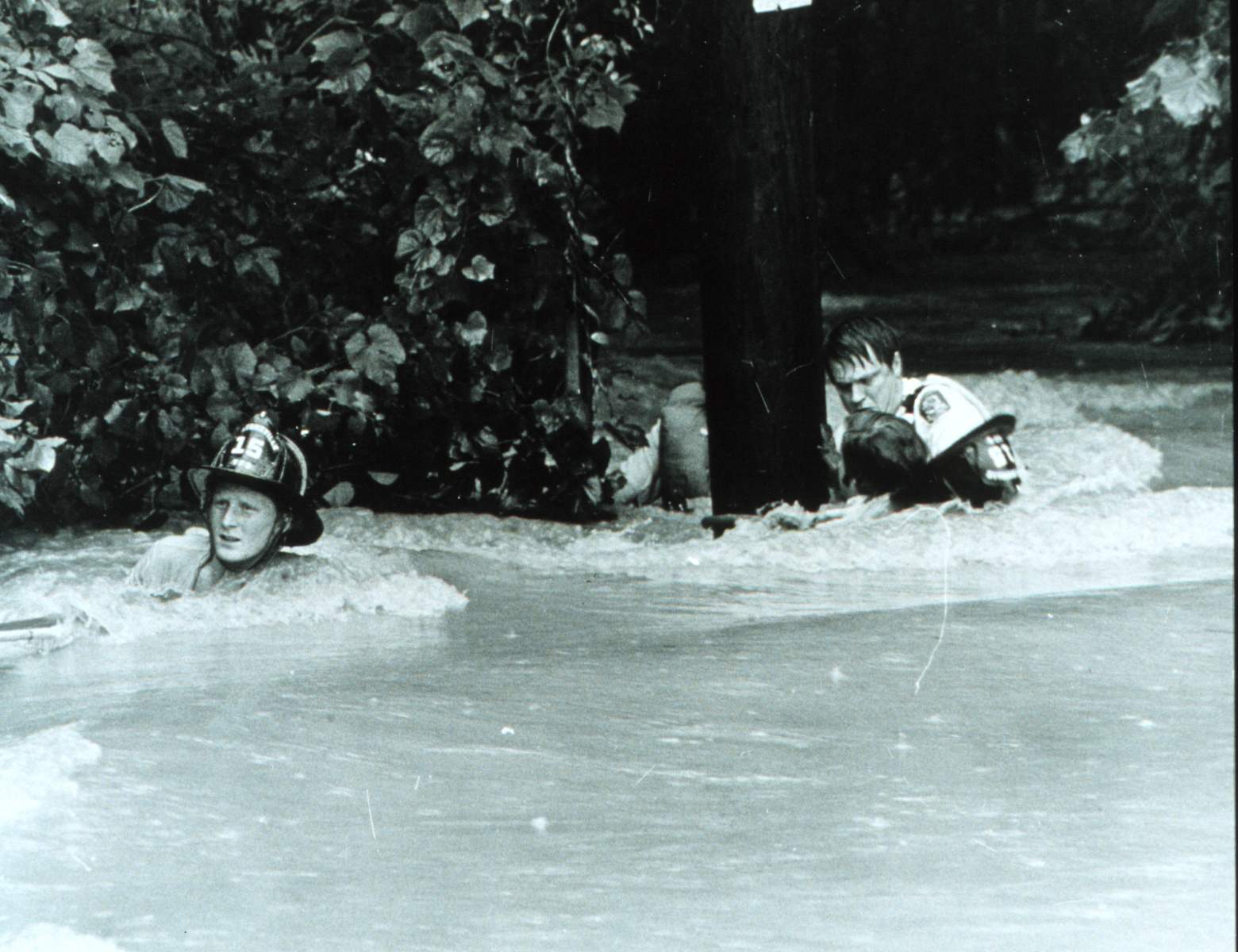
A flood rescue during one of Maryland's storms. If anyone has old photos of Agnes, Hazel or other storms, I would really welcome them for this book project.

All through the summer, I’ve been working on a new book project. GREAT STORMS OF THE CHESAPEAKE is due out next spring—just in time for hurricane season. I’ve been delving into the best (or is that worst?) storms of the last 400 years in the Chesapeake Bay region … mostly in Maryland, but also touching upon Virginia shores because many of the oldest weather records and descriptions of storms seem to be from Virginia.

When one sets out to write about the greatest storms of the Chesapeake Bay region, what you quickly realize is how the anecdotes and facts pile up around you like snow in a February blizzard. Four hundred years of hurricanes and nor’easters, blizzards and gales, waterspouts and hail storms is a lot of weather to cover.

Again and again, I’ve also been reminded that weather is one of the last wild things on the planet, far beyond human control. We’ve come a long way in predicting it and understanding the weather since English explorer Captain John Smith encountered his first Chesapeake Bay squall, yet there’s not much we can do to change it.

As a lifelong Marylander, two weather incidents stand out in my childhood memory. The first is Tropical Storm Agnes in 1972. I hadn’t started kindergarten yet at Lisbon Elementary School, but I can recall how my father drove us a couple of miles down to the Rt. 97 bridge over the south branch of the Patapsco River. The river marked the boundary between Howard and Carroll Counties. Most of the time, the Patapsco was fairly placid, not much more than a large stream that one could easily wade across.

But the deluge of rain from the tropical storm had changed all that. Even the stream on our farm had overflowed, flooding the lower fields. Our stream was yet another tributary of the Patapsco, and the river was now raging as all this water flowed toward the Chesapeake Bay. The bridge was gone, washed away by the rushing waters that now roared as loudly as Niagara Falls to my young ears. All these years later, it’s a memory that’s burned into my mind.

Fortunately, we were high and dry on high ground, watching the river from a safe distance. But downstream, at Ellicott City, the flood had turned deadly. Several victims would die there in the high water. As I discovered in the research for this book, it was not the first time that the Patapsco—normally so calm and overlooked—had turned into a dangerous torrent that swept right into downtown Baltimore.

When we talk about the weather, it often seems like a harmless way to make small talk and pass the time with friends and strangers alike—especially the ones in line with us at the supermarket to buy bread and milk before the next big storm. But as I’ve found from researching this book, when it comes to the weather, it’s anything but a safe topic.


Posted in Delmarva History, Writers & Writing | Leave a comment

Becoming a book trailer addict

Book trailers are a lot of fun, bringing a new and more visual element to the works of fiction and non-fiction. And there’s certainly a precedent thanks to the movie business. I don’t know about you, but I’m hooked on watching movie trailers. I will head over to yahoo movies or trailer addict and check out what’s coming up. In some cases, the trailers might be better than the movies! There is certainly an art to them. Of course, for a writer, the trailers also offer a dose of inspiration because one gets to dip into several stories and come away with what’s most exciting about them.

A trailer boils a movie down to its core elements. Book trailers aren’t quite on the same level, perhaps, but they are still a lot of fun to watch.

One of my favorites is the trailer for LEVIATHAN by Scott Westerfeld. This is more of a Young Adult novel, but it has some wonderfully inventive steampunk and World War I elements.

For a more “homemade” trailer, you might check out the SHIVER trailer over at Maggie Stiefvater’s site. Looks like it was put together in her writing studio, which adds to its charm.

Recently, I decided to create a couple of book trailers of my own. My budget is considerably smaller than Westerfeld’s, I’m sure, so in the spirit of DIY I thought I would give it a whirl with a little help from Corel.

The result was a trailer for WINTER SNIPER and DELMARVA LEGENDS AND LORE. I used a somewhat different approach for each one. I’m happy with how they both turned out, but I will let you be the judge.

If a trailer generates a bit of interest in one of the books, that’s all to the better. I think they do capture, visually, some of the excitement in the books. For DELMARVA LEGENDS AND LORE there is the excitement of discovering local history. WINTER SNIPER is more about the thrill of the story surrounding a plot to assassinate General Eisenhower. I used text and images to capture some of that.

Ultimately, of course, I hope that someone might be curious enough to pick up one of the books and give it a read. DELMARVA LEGENDS AND LORE is available only in print from History Press, while WINTER SNIPER is an ebook from Intracoastal.

Both books are for very different markets and very different readership. Yet I think the “stories” they contain are visually exciting enough for a book trailer.

One by one, as I get time, I will try to create trailers for my other books. It’s just one more job that authors have to take on these days, I suppose, but it does help one think about the visual story at the core of a novel or nonfiction book.

Posted in book trailers, Writers & Writing | Leave a comment

Visit Browseabout Books in Rehoboth Beach

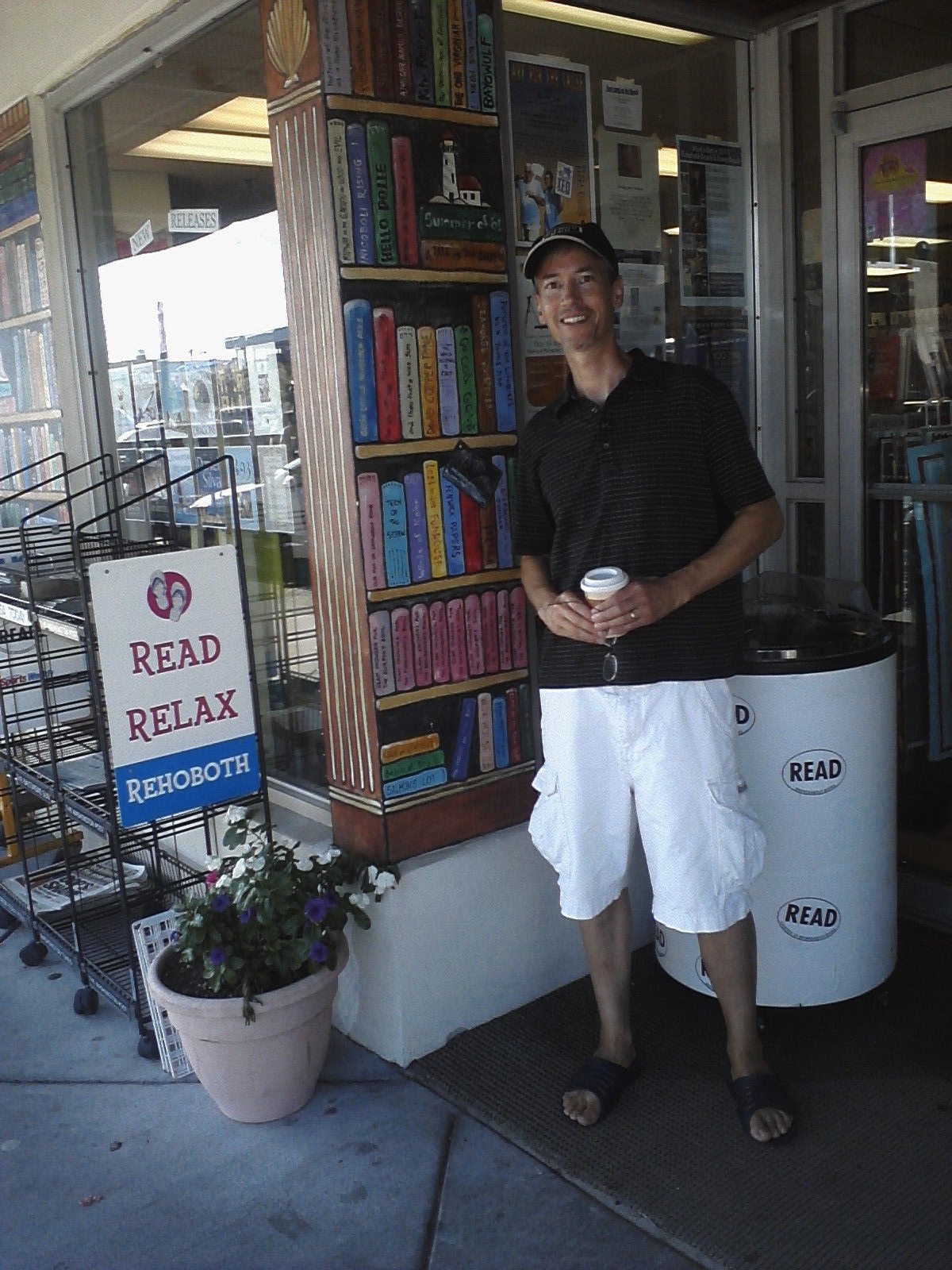
Freshly caffeinated after a visit to Browseabout Books in Rehoboth Beach.

When most people head to the beach, they take along towels, sunscreen, maybe an umbrella. But ranking right up there would be having something to read.

Out on the actual beach, I did see a lot of books (and a few newspapers) not to mention a woman reading her Kindle. I suppose that was a sign of the times.

Just in case you don’t have an ebook reader, or else forget your reading material, or polished it off from the comfort of your beach chair, thank goodness there are still beach town shops that sell books.

One such place in Rehoboth Beach is Browseabout Books. It’s not just books, of course, but an eclectic mix of toys, gifts and coffee, with a smattering of cafe tables where one can plunk down and sip some java.

Browseabout Books struck me as a wonderful place to spend a hot afternoon—which is basically what my son and I did—or perhaps a rainy day. Linger at the coffee pot in the morning and you can catch up on your gossip from the crew of old-timers that settles into the nearby tables.

The nice folks at Browseabout Books were good enough to have me down for a book signing last summer, bright and early on a Sunday morning. There was a big rush for coffee, newspapers and beach books. I was on hand to sign copies of “Delmarva Legends and Lore” and a few readers did pick up an autographed copy to stock the shelves of their guest rooms or else learn a bit more about our history- and story-rich peninsula.

Last week, I stopped by Browseabout Books in Rehoboth Beach to sign another batch of books for them. I was able to spend some times wandering the aisles and sipping coffee. Forget that hot sun! Give me a cool bookstore any day!

They also have a staff picks section that’s full of pleasant surprises. And if you won’t take the staff members’ word for it, they do have the usual New York Times bestsellers in stock.

They have a really nice collection of local books about every regional topic imaginable. If you are a visitor just looking to learn a bit more about the area or else a local who wants to know yet more, the local books section at Browseabout Books is a great place to start.

I found a few gems there, and I hope you will, too 🙂


Posted in Writers & Writing | Leave a comment

Craft books offer writing tips and inspiration

At some point in any writer’s life—whether you are starting out or need a dose of inspiration—a craft book on writing can be useful and helpful. A so-called “craft book” is sort of a writing class and writing companion gathered between two covers. There are several such books on my bookshelf that I turn to time and again, and some that I keep within reach right on my desk. They are great to keep you going … along with a bottomless coffee pot.

Writing can be lonely, and in an era obsessed with “social media” in which we’re expected to fill every waking moment with emails, text messages, tweets and Facebook updates, you can’t help but wonder if there’s something wrong with wanting to be left alone to write something that’s a bit more involved and less instantaneous. On the pages of these books you’ll be reassured that you aren’t the only one trying to put words on paper (or on the screen). Someone has done this before you, and done it well, and they’re willing to share what they’ve learned.

Craft books are something I plan to mention during my upcoming talk, “How to Get Started Writing Your Story (And Publishing Your Work) at 6:30 p.m. Monday, Aug. 22 at the Chesapeake City Branch Library. (Hope to see you there!) Meanwhile, I thought I would share some of my favorite craft books and how—and why—they have been helpful to me.

Favorite craft books on writing:

How to Write Magical Words and magicalwords.net

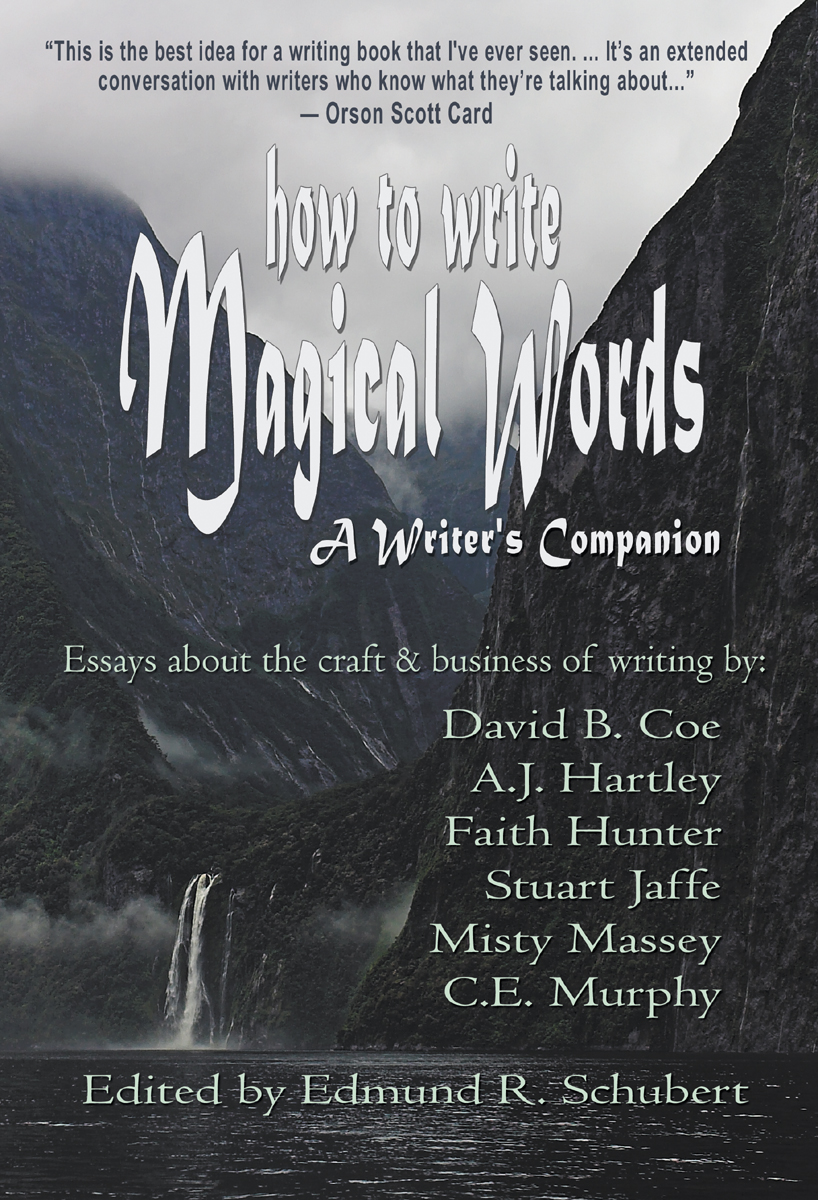
This wonderful book is a compilation of the magicalwords.net blog kept by several accomplished fantasy writers, including Faith Hunter, David B. Coe, Misty Massey, A.J. Hartley and C.E. Murphy. Though geared toward fantasy writing, it’s chock full of practical tips from working writers dealing with everything from getting unstuck, to making a living, to rewrites, to marketing, to coming up with ideas. You can easily visit the blog online, but the book (available in print and as a digital book for your Kindle or Nook) is a resource you will turn to again and again.


Writing the Breakout Novel by Donald Maass

I came across this book several years ago and it remains one of my perennial favorites. Don’t be scared off by the commercial nature of the title, because this is actually a very practical book that shares first-hand accounts of how several well-known authors struggled with concepts or rewrites until they had a good (and sometimes bestselling) manuscript. Examples of good writing, characterization, etc., are pulled right from the pages of popular recent novels and you will be introduced to some writers you might not have known about, but whose work sells well for a reason.


The War of Art by Steven Pressfield

Known for his historical novels, Pressfield’s short and rather “new age” books will get you inspired to step off your creative project, whether it’s writing or getting in shape or launching a business. He writes from the experience of someone who struggled for many years before finding success through hard work. I keep this one on my desk.


The First Five Pages by Noah Lukeman

You can probably guess from the title that this book is all about polishing your manuscript. Have you got a good hook? Here are practical tips on keeping your manuscript in front of editors and readers.


On Writing Well: An Informal Guide to Writing Nonfiction by William Zinsser

I would call this book a “classic” and useful to anyone doing just about any kind of writing for work or school. There is a lot of sound, traditional advice in this book. Best of all, it’s available on the shelves of your local library.


Those are ones I keep on my shelf. Here are a few other craft books available from the library.

  • On Writing: A Memoir of the Craft by Stephen King
  • A Handbook for Teens Who Like to Write by Victoria Hanley
  • Beginnings, Middles, and Ends by Nancy Kress
  • Storycraft: The Complete Guide to Writing Narrative Nonfiction by Jack Hunt
Posted in Writers & Writing | 3 Comments

Chautauqua and the historical society

Harriet Tubman

Thanks to the Maryland Humanities Council, Chautauqua is once again being held this summer. I was asked to introduce Harriet Tubman by speaking about another historical topic, and my comments follow. 

I thought I might get us in a historical frame of mind by talking a bit about the Historical Society of Cecil County. Who we are, what we do, what we offer.

It’s interesting that we’re in this beautiful, historical church today, and it reminds me that Abraham Lincoln once said, “When I hear a man preach, I like to see him act as if he were fighting bees.”

The Historical Society of Cecil County is an organization that is, of course, extremely interested in preserving the past. At the same time, the Historical Society is very much interested in the present — and the future — and these can be challenging times in that regard for any local non-profit organization.

I personally don’t see history as something that’s in the past, over and done with. Our local history lives on in who we are, what we think, and how we act. Some of us are more interested in history because we’ve come out today to learn more about Harriet Tubman. But even those who never heard of Harriet Tubman are affected by what she accomplished and the times in which she lived. You can ignore history, but it won’t ignore you.

Some of you may be familiar with the Historical Society, and if so, please stay with me a moment. We’ll get to the good stuff.

The Society is located at 135 E. Main Street in Elkton, in a building we share with the Cecil County Arts Council. The building is historical in its own right, but it’s really the contents of the building– the society’s collections and resources– that have the real value. Some claim that the building is haunted, but you’ll have to come back in a few months at Halloween if you want to hear spooky stories. 🙂

We have about 1,000 members — mostly from the area but also from around the country. These membership dues are really important to us in paying our bills, providing research resources and outreach.

If you haven’t been to visit us, please do. We have a nicely organized library of maryland books. We also have the DeWitt Military museum, a collection from the late Sheriff Jack DeWitt.

We have local newspapers on microfilm–we’re moving them to a digital archive–including the Cecil Democrat and some you might not have heard of such as the Midlands Journal and Elkton Appeal.

We have a wonderful collection of photographs, many donated by individuals. Very useful if researching your old house or your genealogy.

We’re very lucky to have the Cheeseman collection, which creates a photographic record of Cecil County news and events over a 30-year period, thanks to donation of hundreds of photographs by the late newspaper photographer Jim Cheeseman.

Recently had a very nice donation of tintypes and early photographs from the Ragan family of Conowingo. They are facinating to look at and provide not just a record of a family but also of the development of photography.

Other important collections are the Gilpin collection featuring important colonial-era records and journals, and our collection of tax records and other documents dating from before the Revolutionary War. We recently had a donor who wished to remain anonymous donate a very valuable collection of Cecil County tax documents from the early 1700s that turned up in New York City, which yet again adds to the local resources available.

We also have ancestry.com online that you can come in and use without paying the monthly fee because the society is a subscriber.

So we have a lot of wonderful resources … but the times they are a changin’ . Here’s why.

Our funding from county government has dried up and blown away. That’s happened to all non-profits in the county.

We don’t get nearly the walk-in traffic or visitors that we used to. Traffic is down at nearly all local museums because that’s not really what people want anymore.

Membership has dropped. One theory for the decline in memberships is that the younger demographic (people in the forties and fifties and younger) aren’t “joiners” the way people used to be 20 years ago. And the economy isn’t what it was, either, so if you’re going to cut back, memberships and donations are usually the first thing to go.

So our challenge is to preserve and promote local history by staying relevant in the years ahead.

How?

We are expanding our board of trustees to include some “new blood” and bring in new ideas.

We are offering new programming. We recently had a wonderful exhibit about baseball in Cecil County. The opening was very well-attended and we served hotdogs and peanuts.

We’re planning something similar with Cecil County’s love affair with the automobile.

These have huge popular appeal.

We are partnering with other organizations to promote local history. For example, we are joining forces with the Cecil County Public Library, Cecil County Arts Council to bring in a traveling exhibit from the Smithsonian two years from now called “Peoples and Where they Come from” that will touch on the migration here during the World War 2 years. Partnerships enable everyone to use their strengths to do things that any one group couldn’t just do on its own.

At the same time, we are maintaining our commitment to scholarship by launching a huge undertaking to digitize many of our records and photographs to make them more readily available for historical research.

That’s what we’re up to.

How could you get involved and help preserve and promote local history?

Join. Become a member.

Visit us! Come see what we have. You are welcome to poke around.

Volunteer. We need help digitizing, writing article for The Inkwell, and just keeping up with our collections in general. You can spend two hours a month if you want.

Finally, you can visit our website cecilhistory.org

Thank you for listening and becoming more informed about the Historical Society, one of our great Cecil County resources.

You know, David McCullough once said that, “No harm’s done to history by making it something someone would want to read.”

At the Historical Society, we would say no harm is done my making our local history something that’s accessible to everyone in Cecil County … and beyond!


Posted in News and Events | Leave a comment

Remembering late governor from a reporter’s POV

The late William Donald Schaefer, former Maryland governor.

Historically speaking, William Donald Schaefer was perhaps one of Maryland’s more unforgettable politicians. For several decades, first as Baltimore mayor, then governor and comptroller, he left his stamp on Maryland politics. Though Schaefer was sometimes profane, bluff, and outspoken, he was always memorable. When I was a kid, I recall how we watched him on TV take a swim in the seal tank at the new National Aquarium in Baltimore, wearing an old-fashioned striped swimsuit. Now, there was an elected official who understood the value of a good publicity stunt.

Schaefer made no secret of the fact that he didn’t think much of Maryland’s Eastern Shore, once famously describing it as an outhouse (but using a less polite term). He never really made it clear whether he lumped Cecil County in with the rest of the “outhouse” counties, but it does say something that his visits were rather few and far between. Schaefer was a city boy at heart, and I think rural areas and the rural lifestyle were something he never really understod or appreciated.

Back in the early 1990s, I covered one of those visits as a newspaper reporter, and it was an experience that left me with a lasting impression of “Willie Don,” as he was sometimes nicknamed. Schaefer visited Conowingo Dam to tour the program where shad were caught in a trap below the dam, then trucked to spawning grounds upriver.

The governor wore a charcoal gray suit and tie, which was a bit overdressed for touring a fish lift. No golf shirt or rolled-up sleeves for him. Up close, I noticed he had sort of spooky blue eyes, the sort that don’t register much emotion. They were the sort of eyes that would have suited a machine gunner or a mafia don, and they probably served him well when the going got tough during budget meetings.

He eventually gave a sort of mini-speech about the visit at an impromptu press conference. In hindsight, I realize he must not have taken the tour too seriously, because he started out the speech relating how one of the  fish had been telling him how much he and the other shad enjoyed their trip across the dam. It was all a little wacky, and I was a little disappointed. This was supposed to be my big story about the governor’s visit to Cecil County! I had covered a lot of Elkton town meetings to get my big break! Now Schaefer was blowing it for me by going on about talking fish, for pity’s sake.

But he was nice enough to a backwater and barely old-enough-to-vote reporter, giving me a few minutes one on one to ask him about his impressions of the fish lift. I can’t remember what questions I managed to stammer out, but I’m sure they were pithy and biting questions along the lines of how he had enjoyed his visit.

Schaefer was notoriously hard to quote, and I soon found out why. The man did not speak in complete sentences or even complete thoughts. As a journalist, you find that some public people are very used to working with reporters because they will speak slowly and coherently when they know you are busy writing down their words. They’re old pros at the media game. Schaefer didn’t seem at all concerned about any coherent meaning.

A close proximity to what I jotted in my reporter’s notebook would be this: “Fish … crossing dam … great day for Chesapeake Bay … Save the Bay … beautiful Susquehanna River … wonderful program.”

Quoting Gov. Schaefer was like filling in the blanks for a Mad Lib, or using one of those refigerator magnet sets where you piece together sentences, thoughts and poems out of random words.

I only ever saw him one other time in person, and that was several years later when he was state comptroller, but not necessarily out of the limelight thanks to his sometimes outlandish remarks.

I was doing reserarch at the B&O Railroad Museum in Baltimore for my “Rebel Train” Civil War novel, and took a break to have lunch with an old railroad conducter at a deli on Fort Avenue. That was a popular stop for city politicoes, and in came Schaefer. He was a regular, but his arrival still caused something of a stir. This was as close as Baltimore got to royalty or celebrity. I did not take the opportunity to remind him of what I’m sure was a captivatingly dull story I had written about his visit to the Conowingo Dam many years before.

It’s too soon to really judge Schaefer’s place in Maryland history, but for a newbie reporter—and those apparently talkative shad at Conowingo Dam—Gov. William Donald Schaefer always will be a fond memory.

Posted in Delmarva History, Writers & Writing | Leave a comment

Excerpt from ‘The House that Went Down with the Ship’

An excerpt from my mystery novel set in Chesapeake City:

The Chesapeake City Historical Society and Museum was located in Franklin Hall, a three-story brick structure in the heart of the town’s historic district. Built in 1878, the building had been home to many uses and causes over the years: Masonic hall, arts council, town library, various shops and businesses, even a butcher’s shop in the cellar at the turn of the previous century. (It was the Mason’s who had named it after one of their own, Benjamin Franklin.) The building itself was owned by the town’s historical society, which, I had learned, was constantly struggling to pay the upkeep on Franklin Hall. Even in the short time that Delmarva Renovators had been in town, the historical society had spent more than one hundred thousand dollars to have the building’s foundation overhauled. Our show had taken time out to film the masons as they worked to remove the old mortar between the foundation stones and then painstakingly repointed the cellar walls with an historically correct mortar mixture. To use modern Portland cement would not only have been a travesty, but it might have cracked the original field stone.

Iver Jones was president of the historical society and self-appointed museum curator. As museums went, the Smithsonian it was not. Worn blue carpeting covered the floor and the walls themselves held a menage of black-and-white photographs, old maps, yellowed newspaper clippings and the occasional “artifact” — such as the Civil War sword carried by Captain Ezra Cosden’s father. The leap in time and events from one square foot of wall to another had an effect that was a little like being trapped in an elevator that stopped at random floors. However, the quirky nature of the museum was part of its charm, and on first coming to town I had spent hours reading everything on the walls and poring over the local history books.

In theory, the museum was self-guided, but nine times out of ten visitors received a personal tour from Iver. His antiques shop was located just across the street in one of Canal Town’s oldest houses. No sooner would someone walk into the museum than Iver would pop in after them. Those who knew Iver said these personal tours weren’t motivated as much by his love of history as they were by the fear that a tourist would walk off with something valuable, such as the program from the fire company’s seventieth anniversary banquet back in 1981.

I didn’t have to wait long for Iver to appear. He must have been keeping watch from behind the lacy curtains of his antiques shop. Even though I’d been in town now for several months, he still didn’t trust me alone in “his” museum.

“What can I help you with today, Tom?” he asked, drifting through the museum door with all the grace of a dancer. Iver was short and thin, quite the opposite of what his robust Nordic name might suggest. “Iver” was the sort of name that seemed to suit a Viking better than the effete owner of an antiques shop. It was hard to know Ivy’s exact age, but I was pretty sure he could see seventy in his rearview mirror. Iver was a direct descendant of the Swedish settlers who had arrived on what was now the Delaware coast in 1638, and he never failed to let that fact slip in the first five minutes of any conversation with a newcomer.

Not that he put on airs when it came to his appearance. Iver wore jeans, off-brand sneakers, and a green hoodie patterned with a leaping rockfish and emblazed with the slogan: “Hooked on Chesapeake City!” Iver’s wardrobe usually consisted of whatever sweatshirts and T-shirts he picked up at the end-of-season sales in the gift shops in town. There were severals such shops in town that catered to the tourists, selling everything from those T-shirts to tchotchkes like ceramic frogs with the slogan “Hop on over to Canal Town” and coffee mugs with pictures of the soaring Chesapeake City bridge on them. Iver would sniff in a superior way at Merchant Association meetings as he pointed out that he sold antiques. And it was true that he had a high-end shop that drew buyers from a wide area, though lately the Internet had been taking its toll on his in-store sales. He was very interested in our renovation project, because the Pritchards had been good customers, buying up several local pieces for the house—if and when it was ever finished.

“Just the person I was looking for,” I said. It paid to butter up Iver like an ear of corn, since he held the keys to all those locked filing cabinets filled with town records. “I could use your expert help.”

He shot me a look and set one hand on his out-thrust hip, a move that would have suited an actress in an old black-and-white movie. The butter must have been a little thick, even for Iver. “This must be a good one.”

“Oh, it is,” I said. “What can you tell me about Leo Cosden?”

“Brother to Captain Ezra Cosden,” Iver said right off the bat. He really was like a walking encyclopedia of town history. “He was a captain himself. Drowned in Chesapeake Bay when his ship went down during a storm. I thought you would have known about him.”

Iver somehow managed to make one’s lack of historical knowledge seem to be a serious personal shortcoming, like leaving home without your pants. “Do you have any other information about him?” I asked. “Were there any newspaper accounts of what happened?”

“Well, we might be able to find something. But I am supposed to be running my shop. I guess I could spare a few minutes. What’s so important about Leo Cosden all of a sudden?”

“About twenty minutes ago someone threw a brick through our front window,” I explained. “Leo’s name was scratched on it.”

Iver didn’t so much as blink. “In that case, I can see where it might be worth looking him up.”

I followed him deeper into the museum. The front half of Franklin Hall was rented for shops — selling jewelry and more tchotchkes — but the back half that held the museum had a mysterious air, with tiny rooms hiding off hallways and steps leading down to a cellar that seemed to go on and on. Depending on your point of view, the cellar held either priceless antiques and town mementos, or else piles of rusting and mildewed junk. It really depended on how one viewed the intrinsic value of everything from ferry landing signs to milk bottles from the long-gone Losten’s Dairy just outside town.

“How much do you know about Leo Cosden?” I asked.

“Not much,” Iver said. “He died almost a hundred years ago. It’s his brother, Ezra, who’s the famous one. You do know about him, don’t you? You are working on his house, although I understand not everyone is happy about it.”

Iver must have heard about the slashed tires. News got around this town faster than a stray cat finds a fish bone. I glanced at my tour guide and wondered how long it would be before everyone knew I’d been asking about Leo, the other Cosden. Iver was a notorious gossip. I mean, the man loved to dish.

We climbed a set of creaky stairs. From my previous visits, I knew that the second floor of the museum was off limits to the public. Not that anyone could have gotten far anyway. It was crammed so full of boxes and filing cabinets that I stepped gingerly onto the floor, half afraid that my weight would be all it took to finally collapse the building.

Every time an old person died in Chesapeake City and the relatives cleaned out the attic, Iver was famous for interceding as the boxes headed for the local landfill. They wound up jammed into the second floor instead. These boxes held photographs of long-dead relatives, outdated legal papers, old newspapers. Anything that seemed especially important ended up stuffed for safekeeping into one of the cubbyholes under the eaves.

Iver led the way, switching on low-wattage bulbs that barely cut through the gloom. Blinds covered the dormer windows to keep out the deteriorating effects of sunlight. He was surprisingly agile as he slipped down the narrow walkways between the stacks, almost like a spider dancing down a web. Dust swirled up and made my nostrils twitch. The second floor smelled of old paper, mildew and mice. Something touched my face and I recoiled, then realized it was only a cobweb.

“That’s the late eighteen hundreds over there,” Iver said, gesturing toward a corner. “The early nineteen hundreds are right here. Great Depression in that pile by the back corner.”

“Where do you keep the Ark of the Covenant?” I wondered. “Right behind the Holy Grail?”

Iver didn’t dignify that with an answer. His organizational system might have worked for him, but to me it was all just a jumble of boxes and filing cabinets. We stopped in front of a pint-sized doorway into a cubbyhole. A brass padlock secured the door. A heavy key ring appeared from a deep pocket in the rockfish sweatshirt. Iver was full of surprises. He began flipping through the keys and muttering in a way that reminded me of the old nuns fingering their rosary beads back when I was an altar boy.

“Let’s try this one,” he said, fitting a key to the padlock. He grunted with the effort of trying to turn it. When the lock didn’t open, he went back to the key ring until she found another likely suspect. This time, the lock popped free. He opened the door to reveal the dark depths of a cubbyhole. “This is where I keep the Cosdens,” Iver said. He cleared her throat. “The Cosden family papers, I mean.”

“Okay,” I said. “That’s a start.”

“Go on in and bring out a couple of boxes,” he said. “Let’s see what we can find.”

I had to stoop down to get inside the cubbyhole. I felt around for a light switch. Nothing. Not even a pull cord for an overhead bulb. It was good and dark in there.

“Iver, have you got a flashlight or something? I can’t see a thing.”

“Go on, you’re a big boy. You’re not afraid of a few spiders, are you?”

Well, yeah, as a matter of fact. But it wasn’t like I could expect Iver to haul the boxes out. He was spry enough, but he was an old man. And he took pleasure in ordering people around. I ducked lower and felt my way into the darkness. Just enough light spilled in that I could make out the edges of the boxes stacked inside. And there were enough spider webs in there to weave a parachute out of the silk.

“What am I looking for?”

“Don’t worry, you’re not even close.”

I inched forward. This must be how cave explorers felt. My knees kept running into my elbows as I shuffled inside. I blinked, trying to get used to the darkness. The tiny room felt like it was holding its breath. Something way back in the corner rustled. Crickets, I told myself. Mice.

Let’s get something straight here, okay? I’m not a total wimp. Mice, bugs, bats and snakes don’t bother me much. Spiders, on the other hand, are a different story. I loathe anything with eight legs. Hey, I know arachnids do a lot of good, catching insects and all that, but there’s nothing lovable about them. Glancing once more at the veil of webs, I had a reassuring thought that black widows preferred lairs with more air and sunlight. On the other hand, the place was just right for a brown recluse.

“You have to go farther,” Iver said. “The box I want is toward the back.”

Then maybe you ought to crawl in here and get it. But I kept my thoughts to myself and crept deeper into the cubbyhole. Looking over my shoulder, I could just see Iver’s silhouette in the open doorway. In my mind’s eye I could imagine him shutting the door and snapping that big lock shut. I had another crazy notion, which was that I really didn’t know much about Iver. He might even be a Cosden himself, way back somewhere in his family tree. This town seemed to be full of twisted family roots.

I regretted not telling anyone I was coming here. Nobody would come looking for me anytime soon in a forgotten cubbyhole on the second floor of the Chesapeake City Historical Society. When they finally got around to unlocking the door I would be a twin to the mummy that tumbled out of the wall at the Cosden House. Maybe they could put me in one of the glass display cases downstairs like a relic from a circus sideshow, or maybe a warning to other meddlesome outsiders.

Pushing that thought from my mind, I grabbed a box and started toward the doorway. I tossed it out and started back for another. My head got a good whack against the low ceiling when I forgot to duck. The impact brought down a nest of cobwebs that stuck to my face like shrink wrap. Something lively scurried across my shoulder. It took a real effort not to go running out right then and there—OK, I’ll admit it, running like a little girl—but Iver would have gleefully spread that story around town by suppertime. Even an arachnophobe has his pride. Leo Cosden, you’d better be worth it. I took a deep breath and tried to forget about the spiders as I dragged out another box.

Iver had started rummaging through the boxes. By the time I carried out a fifth box, he was waving a piece of paper at me.

“This is it,” he announced, unfolding an old newspaper clipping. Someone had penciled a date at the top. October 20, 1913. Oddly enough, the newsprint wasn’t nearly as brown and brittle as might be expected. In fact, it was in pretty good shape. I knew that was because old newsprint contained a higher percentage of “rag content” — actual cotton fibers. Books and newspapers today were all wood pulp and chemicals, which was why they turned brown so quickly. However, it wasn’t the quality of the paper I was interested in so much as the events of ninety-plus years ago.

“What does it say?”

“Do you expect me to do everything!” Iver snapped. Not that it bothered me—Iver was famously cranky and overly dramatic. He sighed. “The fact is that I left my cheaters in the shop. My eyes are getting old, Tom. You can read it for yourself.”

With Iver looking over my shoulder, that’s just what I did.

Posted in Writers & Writing | Tagged , , | 2 Comments

Examining ‘Media and Medicine’

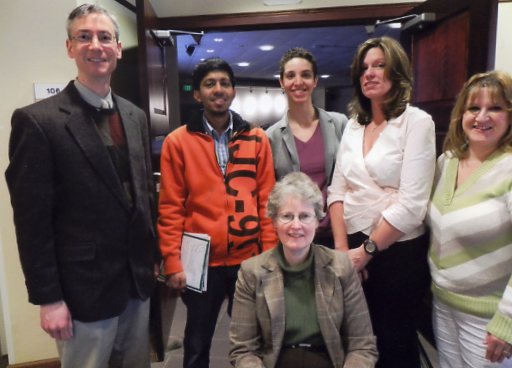
Alpha Alpha Theta members and faculty at the Media and Medicine discussion.

We often think of the connections between “Media and Government” or “Media and Entertainment,” but far less often about “Media and Medicine.” A few weeks ago, the Alpha Alpha Theta Honor Society at Cecil College hosted a meaningful panel discussion on this very topic.

The panel included several faculty members (including their journalism adjunct) and community members who work in the media or medical field.

What transpired was an interesting conversation about the role of the media in either informing the public about a health issue or else about the “power of suggestion” that the media has in terms of marketing pharmaceuticals.

The students had particularly good questions and were highly interested in the topic. At times, the students were so knowledgeable that I felt we had somehow traded places and I was the one sitting in the audience.

One topic we touched upon was related to the threat of a bird flu epidemic, and whether or not the media—even on the local level—was guilty of hype. I disagreed, because the threat of the epidemic was very real. Better to be informed than to take the ostrich approach with one’s head in the sand. I also saw parallels between the threat of a modern epidemic and the Spanish flu epidemic that struck the region nearly a century ago.

All in all, it was a great gathering and thanks to Cecil College’s Alpha Alpha Theta Honor Society for raising the bar for meaningful public discourse on campus.

Posted in News and Events | Leave a comment

‘Constant reinvention is the new reality’

The Poynter Institute Journalism site is one I check periodically for ideas related to the journalism class I teach. Today I was reading the transcript of a live chat about transitioning newspaper skills to other jobs (in or out of actual journalism). The following comment really struck me, because I think it’s good advice to anyone in the rapidly changing writing field.

Joe Grimm, Poynter:

Constant reinvention is the new reality. It would be nice to believe that have to go through a big transition just once, but that is not being realistic. If Plan B becomes your new Plan A, you had better start working on the new Plan B.

Posted in Writers & Writing | Tagged , | Leave a comment

Chaney Scholar Explains 1812: Our Forgotten War With Britain

Chaney Scholar Explains 1812: Our Forgotten War With Britain

By Alex Walls, Staff Writer

Published: April 5, 2011 at 12:10 am

This past week, the Center for the Study of Democracy welcomed this year’s Chaney Visiting Scholar, David Healey, who came to discuss the U.S.’s forgotten war — the War of 1812. The lecture, entitled 1812 in the Maryland Imagination: A Star-Spangled Exploration, gave those present an insight into a part of Maryland history on the eve of the bicentennial of the declaration of war.

The beginning of the talk dealt with French Emperor Napoleon Bonaparte. During the opening years of the 1800s, Bonaparte had plunged Europe into a “world war.” At the same time, relations with Britain and the United States become even more frigid. The British did not recognize the U.S. as a sovereign nation and the Royal Navy kidnapped many U.S. sailors, forcing them to serve on British ships. The British were also funding a “cold war” between the western settlers and the Native Americans.
On June 18, 1812, Congress, on the recommendation of President James Madison, declared war on Great Britain. Madison would be the only President to actually lead troops in battle. However, the war went just as well as the Battle of Bladensburg, also known as the “Bladensburg Races” due to the fact that the American militia raced out of the way as the British marched on Washington.

The problem that faced the U.S. was that it picked the wrong enemy. According to Healey, “after the fall of France, Britain became the world’s first superpower which had the strongest navy and military [in the world].” When peace broke out in Europe, Britain was able to turn its attention to the U.S. front.

The United States was not ready to fight a war since it had virtually no army nor a navy to defend itself. In order to protect the Chesapeake, Joshua Barney built barges that were fast and could attack the Royal Navy’s ships and then hide in the marshes. However, these small boats were no match against the Royal Navy’s “First Rate” ship of the line, “which took 6,000 trees to build, 800 souls to man, and 30 pound guns on several decks,” said Healey.

“By 1813, the British had the Chesapeake Bay locked up more than the King’s bathtub,” joked Healey. However, this was no laughing matter at the time. Under the leadership of Admiral Sir Cockburn, the Royal Marines became the terror of Marylanders. As veterans of the Napoleonic wars, they destroyed most of the resistance of the American militias.  The militias were so bad that “fighting on land, sailors were the best trained soldiers,” said Healey as he described the major disadvantages the Marylanders were facing.

Healey then described several battles, including the defense of Elkton, one of the few victories for the U.S., the burning of Havre de Grace, which galvanized Marylanders against the British, and the well-known Battle of Baltimore and the defense of Fort McHenry.

Healey also mentioned the Legend of Kitty Knight. During the burning of Georgetown (Cecil County, MD) and after the rest of the town fled to the woods, Kitty Knight resisted the British soldiers and protected several older houses within the town. For her bravery, most of the older part of town was saved.
 

Posted in In the News | Leave a comment